Nutritional and Antinutritional Properties of Raw, Fermented, and Germinated Yellow Maize (Zea mays L.)
DOI:
https://doi.org/10.62050/ljsir2026.v4n1.784الكلمات المفتاحية:
Amino acid profile، Anti-nutritional، Fermentation، Germination، Yellow Maizeالملخص
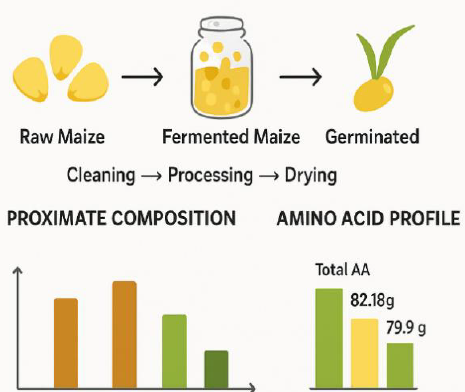
This study evaluated nutritional and anti-nutritional qualities of raw (RM), fermented (FM), and germinated (GM) yellow maize (Zea mays) using traditional home methods. All analyses were performed according to standard procedures. Proximate analysis revealed that germination increased the fiber (10.19 g/100 g) and fat contents, whereas fermentation increased the crude protein (13.56 g/100 g) and carbohydrate (74.03 g/100 g) contents. Antinutrients varied with processing: total phenols decreased from 0.50% in raw maize (RM) to 0.05% in germinated maize (GM); phytate ranged from 289.87 to 450.56 mg/100 g; alkaloids ranged from 7.28 to 12.48%; and tannins ranged from 5.39 to 9.17 mg/100g. The total amino acid content was 82.18 (RM), 79.79 (FM), and 82.33 (GM) g/100 g of crude protein, with valine being the first-limiting amino acid. Germination improved protein quality, whereas fermentation reduced the presence of certain anti-nutrients and protein content. These findings demonstrate that both methods can enhance the nutritional value of maize, thereby supporting the development of an improved maize-based diet.
التنزيلات
المراجع
International Institute of Tropical Agriculture. (n.d.). Maize (Zea mays). IITA. Retrieved December 5, 2025, from https://www.iita.org/cropsnew/maize/
Jilo, T. (2022). Nutritional benefit and development of quality protein maize (QPM) in Ethiopia: Review article. Cereal Research Communications, 50, 559–572. https://doi.org/10.1007/s42976-021-00211-8
Yu, T., Zhang, J., Ma, X., Cao, S., Li, W. and Yang, G. (2024). A multi-omics view of maize’s (Zea mays L.) response to low temperatures during the seedling stage. International Journal of Molecular Sciences, 25(22), 12273. https://doi.org/10.3390/ijms252212273
Piperno, D. R., Ranere, A. J., Holst, I., Iriarte, J. and Dickau, R. (2009). Starch-grain and phytolith evidence for early ninth-millennium B.P. maize from the Central Balsas River Valley, Mexico. Proceedings of the National Academy of Sciences of the United States of America, 106(13), 5019–5024. https://doi.org/10.1073/pnas.0812525106
Gaut, B. S., Díez, C. M. and Morrell, P. L. (2018). Genomics and the archaeological record: The domestication of maize. Current Opinion in Plant Biology, 42, 23–31.
Goodman, M. M. and Galinat, W. C. (1988). The history and evolution of maize. Critical Reviews in Plant Sciences, 7(3), 197–220. https://doi.org/10.1080/07352688809382264
Adiaha, M. S. (2017). The impact of maize (Zea mays L.) and its uses for human development: A review. International Journal of Scientific World, 5(1), 93–95. https://doi.org/10.14419/ijsw.v5i1.7585
Akinsola, O. T., Alamu, E. O., Otegbayo, B. O., Menkir, A. and Maziya-Dixon, B. (2021). Nutritional properties of ogi powder and sensory perception of ogi porridge made from synthetic provitamin A maize genotype. Frontiers in Nutrition, 8, Article 685004. https://doi.org/10.3389/fnut.2021.685004
Kahajdova, Z., and Karovicova, J. (2007). Fermentation of cereals for a specific purpose. Journal of Food and Nutrition Research, 46, 51–57.
Kumar, P., Choudhary, M., Hossain, F., Singh, N. K., Choudhary, P., Gupta, M., Singh, V., Chikappa, G. K., Kumar, R., Kumar, B., Jat, S. L. and Rakshit, S. (2019). Nutritional quality improvement in maize (Zea mays): Progress and challenges. The Indian Journal of Agricultural Sciences, 89(6), 895–911. https://doi.org/10.56093/ijas.v89i6.90756
FAO. (2022). Maize in human nutrition. Food and Agriculture Organization of the United Nations
Chauhan, D., Kumar, K., Ahmed, N., Pal Singh, T., Thakur, P. S., Hyder Rizvi, Q.-U.-E., Yadav, A. N. and Dhaliwal, H. S. (2022). Effect of processing treatments on the nutritional, anti-nutritional, and bioactive composition of blue maize (Zea mays L.). Current Research in Nutrition and Food Science Journal, 10(1), 171–182. https://doi.org/10.12944/CRNFSJ.10.1.12
Avezum, L., Rondet, E., Mestres, C., Achir, N., Madode, Y., Gibert, O., Lefevre, C., Hemery, Y., Verdeil, J.-L. and Rajjou, L. (2022). Improving the nutritional quality of pulses via germination. Food Reviews International. Advance online publication. https://doi.org/10.1080/87559129.2022.2063329
Igbua, F. Z., Adejo, S. O., Igoli, N. P. and Daagema, A. A. (2020). Antinutrients and bioavailability of nutrients in maize, cassava and soybeans composite flour. Asian Food Science Journal, 16(2), 5–12. https://doi.org/10.9734/AFSJ/2020/v16i230167
Oluwajoba, E. O., Akinyosoye, F. A. and Adetuyi, F. C. (2018). Reduction of antinutrients in maize through fermentation. Journal of Food Biochemistry, 42(6), e12568.
Gunathunga, C., Senanayake, S., Jayasinghe, M. A., Brennan, C. S., Truong, T., Marapana, U. and Chandrapala, J. (2024). Germination effects on nutritional quality: A comprehensive review of selected cereals and pulses changes. Journal of Food Composition and Analysis, 128, 106024. https://doi.org/10.1016/j.jfca.2024.106024
Cui, L., Li, D., & Liu, C. (2012). Effect of fermentation on the nutritive value of maize. International Journal of Food Science & Technology, 47(4), 755–760. https://doi.org/10.1111/j.1365-2621.2011.02904.x
Olaniran, A. F., & Abiose, S. H. (2019). Nutritional evaluation of enhanced unsieved ogi paste with garlic and ginger. Preventive Nutrition and Food Science, 24(3), 348–356. https://doi.org/10.3746/pnf.2019.24.3.348
Malek, M., & Ghaderi Far, F. (2022). Dynamics of seed dormancy and germination at high temperature stress is affected by priming and phytohormones in rapeseed (Brassica napus L.). Journal of Plant Physiology, 269, 153614. https://doi.org/10.1016/j.jplph.2021.153614
Kewuyemi, Y. O., Kesa, H. and Adebo, O. A. (2022). Biochemical properties, nutritional quality, colour profile and techno functional properties of whole grain sourdough and malted cowpea and quinoa flours. International Journal of Food Science & Technology, 57(3), 1527–1543. https://doi.org/10.1111/ijfs.15512
Wang, J., Ma, Y. and Huang, X. (2023). Changes in physio-biochemical metabolism, phenolics and antioxidant capacity of different Chinese pea varieties during germination. International Journal of Food Science & Technology, 58(1), 167–180. https://doi.org/10.1111/ijfs.16185
AOAC (Association of Official Analytical Chemists), Official method of analysis of the AOAC, W. Horwitz (Ed.), Thirteenth Edition, Washington DC, 1980. https://archive.org/details/gov.law.aoac.methods.1980/page/n5/mode/2up.
Paul, A.D., Southgate, A. T. and Russel, J. (1976). First Supplement to McCane and Widdowson's The Composition of Foods. HMSO, London.
Aremu, M. O., Olaofe, O. and Akintayo, E.T. (2006). Mineral and aminoacid composition or Bambara groundnul (Vigna suoterranean) and Kerstings groundnut (Kerstingiella geocarna) flour. International Journal of Chemistry, 16, 57-64.
Adejumo, B. A., Ajayi, O. B. and Fadahunsi, I. F. (2020). Effect of germination and fermentation on the nutritional quality of maize. Journal of Applied Sciences and Environmental Management, 24(3), 507–512.
FAO/WHO. Protein quality evaluation report of Joint FAO/WHO Expert Consultative FAO Food and Nutrient. FAO, Rome, Italy. 1991.
Alsmeyer, R. H., Cunigham, A. E. and Hapich, M. L. (1974). Equations predicted (PER) from amino acid analysis. Food Technology. 28, 34-38.
Adejumo, B. A., Ajayi, O. B. and Fadahunsi, I. F. (2020). Effect of germination and fermentation on the nutritional quality of maize. Journal of Applied Sciences and Environmental Management, 24(3), 507–512.
Al Taher, F. and Nemzer, B. (2023). Effect of germination on fatty acid composition in cereal grains. Foods, 12(17), 3306. https://doi.org/10.3390/foods12173306
Christian, E. E., Stanley, C. I. and Emmanuel, C. I. (2019). Proximate and Mineral Composition of Sesamum Indicum L. Seed. Med & Analy Chem Int J 2019, 3(4): 000152
Al Taher, F. and Nemzer, B. (2023). Effect of germination on fatty acid composition in cereal grains. Foods, 12(17), 3306. https://doi.org/10.3390/foods12173306
Chaves-López, C., Serio, A., Grande-Tovar, C. D., Cuervo-Mulet, R., Delgado-Ospina, J. and Paparella, A. (2014). Traditional fermented foods and beverages from a microbiological and nutritional perspective: The Colombian heritage. Comprehensive Reviews in Food Science and Food Safety, 13(5), 1031–1048. https://doi.org/10.1111/1541-4337.12098
Hotz, C. and Gibson, R. S. (2007). Traditional food-processing and preparation practices to enhance the bioavailability of micronutrients in plant-based diets. Journal of Nutrition, 137(4), 1097–1100. https://doi.org/10.1093/jn/137.4.1097
Adebo, J. A., Njobeh, P. B., Gbashi, S., Oyedeji, A. B., Ogundele, O. M. and Oyeyinka, S. A. (2022). Fermentation of cereals and legumes: Impact on nutritional constituents and nutrient bioavailability. Fermentation, 8(2), 63. https://doi.org/10.3390/fermentation8020063
Singh, A., Rehal, J., Kaur, A. and Jyot, G. (2015). Enhancement of attributes of cereals by germination and fermentation: A review. Critical Reviews in Food Science and Nutrition, 55(11), 1575–1589. https://doi.org/10.1080/10408398.2012.706661
Agblemanyo, E. F. and Abrokwah, K. (2019). Effect of traditional fermentation process on the nutrient and anti-nutrient content of maize and African locust beans. Journal of Food Science and Nutrition Research, 2(2), 65–75. https://doi.org/10.26502/jfsnr.2642-11000010
Nwadi, O. M. M.., Uchegbu, N, and Okonkwo, T. M. (2019). Effect of processing methods on the antinutrient reduction of Bambara groundnut: A review. Sky journal of Food Science.7(3), 37-41
Marfo, E. K., Simpson, B. K., Idowu, J. S. and Oke, O.L. (1990). Effect of local food processing on phytate levels in cassava, cocoyam, yam, maize, sorghum, rice, cowpea and soybean. J. Agric. Food Chem. 38, 1580–1585.
Sokrab, A. M., Ahmed, I. A. M. and Babiker, E. E. (2012). Effect of germination on antinutritional factors, total, and extractable minerals of high and low phytate corn (Zea mays L.) genotypes. Journal of the Saudi Society of Agricultural Sciences, 11(2), 123–128. https://doi.org/10.1016/j.jssas.2012.02.002
Popova, A. and Mihaylova, D. (2019). Antinutrients in plant-based foods: A review. The Open Biotechnology Journal, 13(1), 68–76. https://doi.org/10.2174/1874070701913010068
Johnson, I. T., Gee, J. M., Price, K., Curl, C. and Fenwick, G. R. (1986) Influence of saponins on gut permeability and active nutrient transport in vitro. J Nutr 116(11): 2270-7
Spring, B. (1984). Recent research on the behavioral effects of tryptophan and carbohydrate. Nutrition and Health, 3(1–2), 55–67. https://doi.org/10.1177/026010608400300204
Wyatt, R. J., Chase, T., Engelman, K., Kupfer, D. J., Scott, J., Sjoerdsma, A., Fram, D. H., & Snyder, F. (1970). Effects of L-tryptophan (a natural sedative) on human sleep. The Lancet, 296(7678), 842–846. https://doi.org/10.1016/S0140-6736(70)92015-5
Smith, K. A., Fairburn, C. G., & Cowen, P. J. (1997). Relapse of depression after rapid depletion of tryptophan. The Lancet, 349(9056), 915–919. https://doi.org/10.1016/S0140-6736(96)07044-4
Victor, I. A., and Ogunba, B. O. (2018). Potential complementary food from quality protein maize (Zea mays L.) supplemented with sesame (Sesamum indicum) and mushroom (Oudemansiella radicata). Journal of Nutrition & Food Sciences, 8(3), 698. https://doi.org/10.4172/2155-9600.1000698
Egbedike, C. N., Odoh, N. E., Odoh, M. O. and Okorie, P. A. (2024). Evaluation of amino acid profile, protein quality and pasting properties of pap made from fermented maize starch and red kidney beans. Journal of Home Economics Research, 30(2). Retrieved from https://journals.heran.org/index.php/JHER/article/view/23
Smriga, M., Ando, T., Akutsu, M., Furukawa, Y., Miwa, K. and Morinaga, Y. (2007). Oral treatment with L-lysine and L-arginine reduces anxiety and basal cortisol levels in healthy humans. Biomedical Research, 28(2), 85–90. https://doi.org/10.2220/biomedres.28.85
Obizoba, I.C. and Egbuna, H.I. (1992) Effect of Germination and Fermentation on the Nutritional Quality of Bambara Nut (Voandzeia subterranea L. Thouars) and Its Product (Milk). Plant Foods for Human Nutrition, 42, 13-23.
Nkhata, S. G., Ayua, E., Kamau, E. H. and Shingiro, J. B. (2018). Fermentation and germination improve nutritional value of cereals and legumes through activation of endogenous enzymes. Food Science & Nutrition, 6(2), 2446–2458. https://doi.org/10.1002/fsn3.846
FAO/WHO. (1998). Carbohydrates in Human Nutrition: Report of a Joint FAO/WHO expert consultation, 14-18 April 1997, Rome. FAO Food and Nutrition Paper No. 66. Rome.
التنزيلات
منشور
إصدار
القسم
الرخصة
الحقوق الفكرية (c) 2026 Matthew Olaleke Aremu, Benjamin Musa, Victoria Idowu Adeeyo, Hamza Ibrahim Muhammad, Mohammed Alhaji Mohammed, Francis Busuyi Iyiola, Edward Bebe Ayakeme (Author)

هذا العمل مرخص بموجب Creative Commons Attribution-ShareAlike 4.0 International License.
كيفية الاقتباس