Identification and Characterization of Citric Acid-Producing Fungi from Soil and Melon (Cucumeropsis mannii) Rind Samples Collected from Melon Farm in Lafia, Nasarawa State, Nigeria
Keywords:
Citric acid , fungi isolate , Aspergillus niger , fermentation process , microbial isolation and screeningAbstract
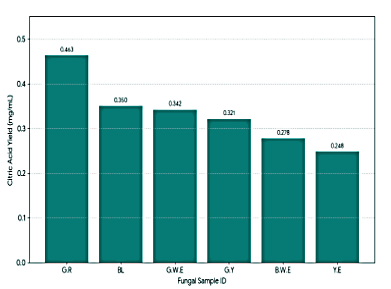
The essential and important organic acid used industrially worldwide for microbial fermentation especially filamentous fungi is citric acid. In this investigation, soil and melon rind (Cucumeropsis mannii) samples from melon farms in Lafia, Nasarawa State, Nigeria. These was used to isolate, screen, identify, and characterize citric acid-producing fungi. Standard microbiological culture protocols were used for serial dilution followed by plating on Potato Dextrose Agar (PDA). The samples were also cultivated on Czapek-Dox Agar (CZA) enriched with bromocresol green to specifically achieve acidogenic strains isolates. This specialized medium allowed for the identification of potent isolates with observable translucent halo zones around the colonies. Green colonies were the most common of the 212 fungal colonies that were obtained. Morphological and microscopic characterization revealed the presence of several fungal genera, including Aspergillus niger, Aspergillus flavus, Aspergillus tamarii, Penicillium spp., Fusarium spp., and Rhizopus stolonifer. Out of the characterise4d and identified fungus Aspergillus niger shows highest potential for citric acid production. The results highlighted the possibility to use melon rind as an inexpensive substrate for industrial fermentation operations and revealed the abundance of native fungi in soil and agricultural leftovers capable of generating citric acid. This research shows how local microbial sources can be effectively used in industries and biotechnological projects.
Published
How to Cite
Issue
Section
Copyright (c) 2026 Adamude Adis Fatima, Abdulrahman Muhammad, Abdulrazak Mohammed Adewumi, Hassan Badeggi Muhammad (Author); Monday Nwankwo (Translator); Femi Ayo Gbadeyan, Umbugadu Shiri (Author)

This work is licensed under a Creative Commons Attribution-ShareAlike 4.0 International License.
How to Cite
Similar Articles
- Ganiyu Shittu Olahan , Ibrahim Ajadi, Patience Olayinka Ben-uwabor, Sunday Emmanuel Adebayo, Characterization of Fungal Contaminants in Fermented Locust Beans in Kwara State: Implications for Food Safety , Lafia Journal of Scientific and Industrial Research: Volume 3, Issue 1 (April, 2025), Lafia Journal of Scientific and Industrial Research (LJSIR)
- Peter Uteh Upla, Bashiru Eya Sani, Osuyi Gerard Uyi, Igoche Naomi Ibe, Salamatu Idris, Oluwatosin Okunade, Naja'atu Shehu Hadi, Abdulaziz Aliyu Dardau, Kabiru Shuaibu, Fatima Yusuf Al-Mustapha, Gladys Abel Angbalaga, Hand Carriage of Microorganisms by Students of Federal University of Lafia, Nasarawa State, Nigeria , Lafia Journal of Scientific and Industrial Research: Volume 1, Issue 1 & 2 (October, 2023), Lafia Journal of Scientific and Industrial Research (LJSIR)
- Murshida Abdullahi Ganuwa, Pedro Akharenegbe, Hannah Eyo Nsemoh, Isah Ibrahim Okposhi, Olukayode Orole, Resistance to Azole Drugs by Fungal Species Isolated from Date Palm Samples within Lafia Metropolis, Nigeria , Lafia Journal of Scientific and Industrial Research: Volume 2, Issue 2 (October, 2024), Lafia Journal of Scientific and Industrial Research (LJSIR)
- Olukayode Olugbenga Orole, Henry David Dimut, Femi Gbadeyan, Phylogenetic Characterisation of Antimycotoxigenic Fungal and Bacterial Endophytes from Maize Roots , Lafia Journal of Scientific and Industrial Research: Volume 4, Issue 1 (April, 2026), Lafia Journal of Scientific and Industrial Research (LJSIR)
- Osuyi Gerard Uyi, Olabisi Peter Abioye, Jeremiah Bala, Philip Alkali Tsado, Sudesh Kumar, Syauqi Ahmad, Isolation and Optimization of Phosphorus Solubilizing Bacteria from Maize Rhizosphere in Nasarawa State, Nigeria , Lafia Journal of Scientific and Industrial Research: Volume 1, Issue 1 & 2 (October, 2023), Lafia Journal of Scientific and Industrial Research (LJSIR)
- Ogbonnaya Nkechinyere Agwa, Owoseni Mojisola Christiana, Aleruchi Chuku, Nworie Chukwuemeka Richard, Crude and Nano Enhanced Antifungal Properties of Acalypha wilkesiana leaf extract against Trichophyton mentagrophytes , Lafia Journal of Scientific and Industrial Research: Volume 4, Issue 2 (October, 2026), Lafia Journal of Scientific and Industrial Research (LJSIR) [IN PROGRESS]
- Osuyi Gerard Uyi, Bashiru Eya Sani, Olukayode Orole, Gift Chidiebere Ejindu, Afamefuna Okafor Dunku, Aleruchi Chuku, Peter Uteh Upla, Isolation and Characterization of Phosphorus Solubilizing Bacteria from Millet Rhizosphere in Lafia metropolis , Lafia Journal of Scientific and Industrial Research: Volume 2, Issue 1 (April, 2024), Lafia Journal of Scientific and Industrial Research (LJSIR)
- Matthew Olaleke Aremu, Benjamin Musa, Victoria Idowu Adeeyo, Hamza Ibrahim Muhammad, Mohammed Alhaji Mohammed, Francis Busuyi Iyiola, Edward Bebe Ayakeme, Nutritional and Antinutritional Properties of Raw, Fermented, and Germinated Yellow Maize (Zea mays L.) , Lafia Journal of Scientific and Industrial Research: Volume 4, Issue 1 (April, 2026), Lafia Journal of Scientific and Industrial Research (LJSIR)
- Olukayode Olugbenga Orole, Oluwatosin Okunade, Bashir Sani, Grace Kwala, Stella Ladi Ageba, Timothy Adejumo, Rhizosphere Microbial Community Structure of Transgenic versus Non-Transgenic Maize Varieties , Lafia Journal of Scientific and Industrial Research: Volume 4, Issue 1 (April, 2026), Lafia Journal of Scientific and Industrial Research (LJSIR)
- Aleruchi Chuku, Bashiru Eya Sani, Pedro Akharenegbe, Godwin Attah Obande, Prevalence and Antifungal Susceptibility of Fungal Isolates Associated with Otomycotic Patients in Lafia , Lafia Journal of Scientific and Industrial Research: Volume 1, Issue 1 & 2 (October, 2023), Lafia Journal of Scientific and Industrial Research (LJSIR)
You may also start an advanced similarity search for this article.