Seroprevalence and risk factors of Hepatitis B and C Virus infection Among Inmates in a Correctional Service, Nasarawa State, Nigeria
DOI :
https://doi.org/10.62050/ljsir2024.v2n1.301Mots-clés :
Hepatitis, correctional service, inmates, risk factors, SeroprevalenceRésumé
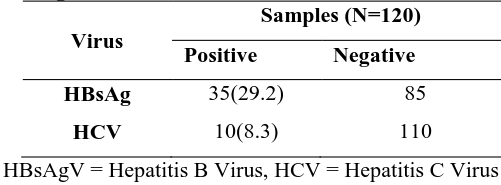
Hepatitis infection has remained a reoccurring public health challenge. The seroprevalence of Hepatitis B and Hepatitis C virus infection among inmates in Lafia correctional service, Nasarawa State, Nigeria was assessed. Blood samples of 120 inmates were screened using the HBV surface antigen (HBsAg) rapid test Dip-strip and HCVAb plus rapid test strip. Socio-demographic and risk factors were analyzed using Fishers exact test binary logistics regression (p ≤ 0.05). Inmates were 29.16 % HBV and 8.3% HCV seropositive. Male inmates were 30% HBV and 8.18% HCV and females were 20% HBV and 10% HCV seropositive. Inmates ≥ 40 years and married inmates are more likely to be infected with HBV and HCV infections. Illicit drug use and incarceration above 5 years were risk factors significant for HBV and HCV prevalence. The high seroprevalence and risk factors of HBV and HCV infections among inmates needs prompt sensitization, screening and vaccination programmes.
##plugins.themes.default.displayStats.downloads##
Références
World Health Organization. Global health sector strategy on viral hepatitis 2016–2021 (2016). Towards ending viral hepatitis. World Health Organization. Available on https://apps.who.int/iris/handle/10665/246177. Accessed: 23/03/203.
World Health Organization. Global Hepatitis Report. Geneva: Switzerland. 2017; World Health Organization (WHO). (2017) Available on https://apps.who.int/iris/bitstream/handle/10665/255016/9789241565455-eng.pdf?sequence=1&isAllowed=y. Accessed: 23/03/2023.
Olayinka A.T., Oyemakinde A., Balogun, M. S., Ajudua A., Nguku, P., Aderinola, M. (2016) Seroprevalence of Hepatitis B Infection in Nigeria: A National Survey. Am J Trop Med Hyg; 95(4), 902–907. https://doi.org/10.4269/ajtmh.15-0874.
World Health Organization. Hepatitis B. 2014. Available at: http://www who.inf/inf-s/ en/fact204.html. Accessed: 23/03/2023.
Gétaz,, L., Casillas, A, Siegrist, C. et al. (2018). Hepatitis B prevalence, risk factors, infection awareness and disease knowledge among inmates: a cross-sectional study in Switzerland’s largest pre-trial prison. J Global Health; 8 (2): 1 -11. https://doi.org/10.7189/jogh.08.020407.
Jafari, S., Buxton, J.A., Afshar, K., Copes, R., Baharlou, S. (2012). Tattooing and risk of hepatitis B: a systematic review and meta-analysis. Can J Public Health; 103:207-12. Medline:22905640..
Uchechukwu, O.F., Abdulrahman, Y., Aliyu, A.U., Mustaphar, U., Zama. I., Charles, A.T. (2018). Seroprevalence of HIV, HBsAg and HCV among Prisoners in Sokoto, Nigeria. Asian J Med Health; 13(3): 1-8. ISSN:2456-8414.
Adoga M.P., Banwat, E.B., Forbi, J.C., Nimzing, L., Pam, C.R., Gyar, S.D. (2009). Human immunonodeficiency virus, hepatitis B virus and hepatitis C virus: seroprevalence, co-infection and risk factors among prison inmates in Nasarawa State, Nigeria. J Infect Dev Countries; 3(7):539-547.
Dan-Nwafor, C.C. Adeoye, I., Aderemi, K., Onuoha, M., Adedire, E, Bashorun, A. et al. (2021). Serological markers and risk factors associated with Hepatitis B virus infection among Federal Capital Territory prison inmates, Nigeria: Should we be concerned? PloS One 16 (3): e0248045. https://doi.org/10.1371/journal.pone.0248045.
Kassa Y, Million, Y, Biset S, Moges F. (2021). Hepatitis B and Hepatitis C Viral Infections and Associated Factors Among Prisoners in Northeast Ethiopia. J Blood Med; 12: 561–570. https://doi.org/10.2147/JBM.S314556.
Ajuwon B I, Yujuico I, Roper K, Richardson A, Sheel M, L. (2021). Hepatitis B virus infection in Nigeria: a systematic review and meta-analysis of data published between 2010 and 2019. BMC Infectious Dis.; 21:1120. https://doi.org/10.1186/s12879-021-06800-6.
Okafor I.M., Ugwu SO and Okoroiwu H U. (2020). Hepatitis C virus infection and its associated factors among prisoners in a Nigerian prison. BMC Gastroenterol; 20:360. https://doi.org/10.1186/s12876-020-01504-8.
Musa B.M., Bussell S., Borodo, M.M., Samaila, A.A., Femi, O.L. (2015). Prevalence of hepatitis B virus infection in Nigeria, 2000-2013: A systematic review and meta-analysis. Nig J Clin Pract; 18(2): 163 -172.
Babatope, I.O., Inyang N.J., Imhanrenezor, K, Aghahowa A. (2015). Seroprevalence of Hepatitis B and C viruses among apparently healthy adults in Ekpoma, Edo State, Nigeria. SVPJ 1(1):0015–20.
Luciani, F., Bretaña, N.A., Teutsch, S. et al. (2014). A prospective study of Hepatitis C incidence in Australian prisoners. Addiction; 109: 1695-1706. https://doi.org/10.1111/add.12643.
Gough E, Kempf MC, Graham L, et al. HIV and Hepatitis B and C incidence rates in US correctional populations and high - risk groups: a systematic review and meta-analysis. BMC Public Health 2010; 10:777.
Téléchargements
Publiée
Numéro
Rubrique
Licence
(c) Copyright Lafia Journal of Scientific and Industrial Research 2024

Ce travail est disponible sous licence Creative Commons Attribution - Pas d’Utilisation Commerciale - Partage dans les Mêmes Conditions 4.0 International.
Comment citer