Antitrypanosomal Activity and Acute Toxicity of Euphorbia hirta Leaf Extract and a Green-Synthesized Vanadium-Based Nanoparticles against Trypanosoma brucei brucei in Mice
Keywords:
Euphorbia hirta , Vanadium nanoparticles , Anti-trypanosomal activity , Trypanosoma brucei brucei , Phytochemicals , African trypanosomiasisAbstract
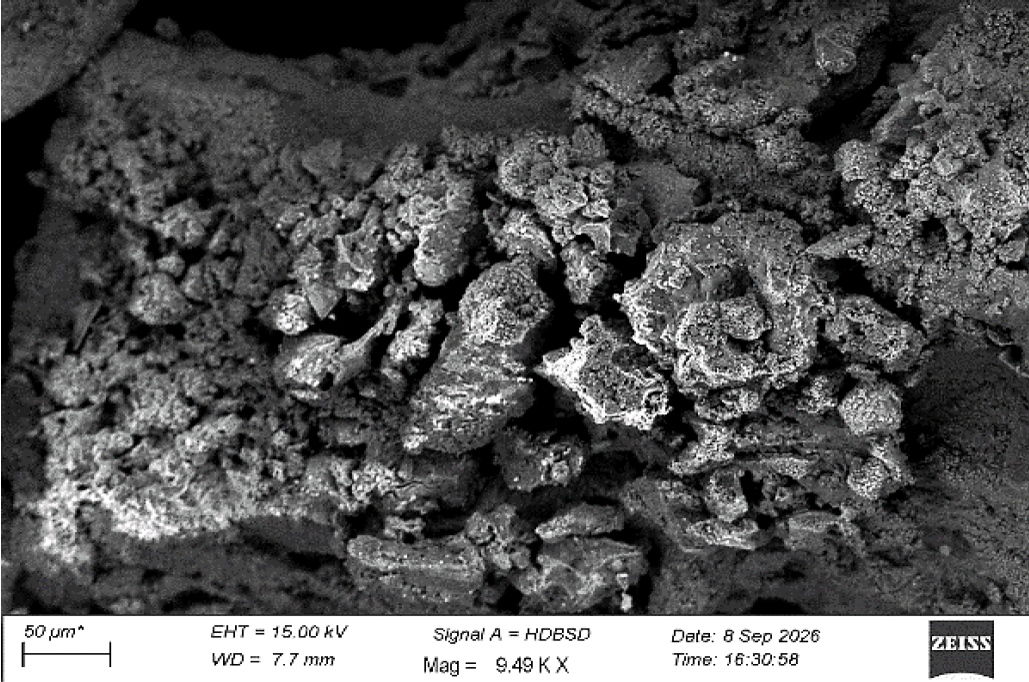
African trypanosomiasis remains an important parasitic disease for which limitations associated with existing trypanocidal drugs necessitate alternative therapeutic approaches. This study evaluated the phytochemical composition, in vitro and in vivo antitrypanosomal activity, and acute toxicity of aqueous Euphorbia hirta leaf extract and green-synthesized vanadium nanoparticles against Trypanosoma brucei brucei in mice. Aqueous E. hirta leaf extract was subjected to phytochemical and GC–MS analyses and used for green synthesis of vanadium nanoparticles, which were characterized by FTIR and SEM. Acute toxicity was assessed using Lorke’s method. In vitro and in vivo antitrypanosomal activities were evaluated against T. brucei brucei, with parasitaemia, body weight, PCV, and histopathological changes assessed in infected mice. Phytochemical screening detected alkaloids, flavonoids, tannins, saponins, steroids, terpenoids, coumarins, carbohydrates, and proteins, while GC–MS identified 25 constituents. In vitro, both treatments inhibited parasite motility in a concentration- and time-dependent manner, with complete inhibition at 10 mg/mL. Acute toxicity testing indicated LD₅₀ values ≥ 3000mg/kg for the synthesized nanoparticles and ≥ 5000mg/kg for the leaf extract. In vivo, significant differences were observed among treatment groups for parasitaemia (H = 18.30, p = 0.006), body weight (H = 19.19, p = 0.004), and PCV (H = 16.09, p = 0.012). Histopathological examination showed reduced tissue alterations in treated mice compared with infected untreated controls. E. hirta extract and green-synthesized vanadium nanoparticles demonstrated preliminary parasite-suppressive activity but were less effective than diminazene aceturate. Further studies incorporating dose optimization, mechanistic investigations, pharmacokinetics, and long-term safety assessment are suggested.
Published
How to Cite
Issue
Section
Copyright (c) 2026 Funmilayo Ibilola Paul, James Ishaku Maikenti, Akwashiki Ombugadu, Mohammed Ahmed Ashigar, Hussein Oshomah Ahmed, Victoria Adamu Pam (Author)

This work is licensed under a Creative Commons Attribution-ShareAlike 4.0 International License.
How to Cite
Similar Articles
- Aleruchi Chuku , Osuyi Gerard Uyi, Godwin Attah Obande , Ayomide Hassan Labulo, Promise Ujunwa Ikechukwu, Characterization and Deployment of Zinc Oxide Nanoparticles of Edible Mushroom with Antifungal Activity against Selected Dermatophytic Fungi , Lafia Journal of Scientific and Industrial Research: Volume 4, Issue 1 (April, 2026), Lafia Journal of Scientific and Industrial Research (LJSIR)
- T. O. Okugbo, U. Shemishere, C. B. Gomo, F. Aghayere, O. Erhovwosere, J. Taiwo, G. A. Jaboro, Preliminary Phytochemical Screening and Acute Toxicity Study of Methanol leaf extracts of Musanga cercropioides , Lafia Journal of Scientific and Industrial Research: Volume 2, Issue 1 (April, 2024), Lafia Journal of Scientific and Industrial Research (LJSIR)
- Ayorinde O. Nejo, Ademola J. Adetona, Adetoun Lawal, Green Synthesis of Nickel Oxide Nanoparticles and its Application in the Degradation of Methyl Red , Lafia Journal of Scientific and Industrial Research: Volume 2, Issue 2 (October, 2024), Lafia Journal of Scientific and Industrial Research (LJSIR)
- Olukayode Olugbenga Orole, Henry David Dimut, Femi Gbadeyan, Phylogenetic Characterisation of Antimycotoxigenic Fungal and Bacterial Endophytes from Maize Roots , Lafia Journal of Scientific and Industrial Research: Volume 4, Issue 1 (April, 2026), Lafia Journal of Scientific and Industrial Research (LJSIR)
- Felicia N. Ejiah, Tolulope M. Fasina, Neerish Revaprasadu, Folasade T. Ogunsola, Oluwole B. Familoni, Antibacterial potentials and DNA study of cobalt(II) complexes containing aminophenol Schiff base moiety , Lafia Journal of Scientific and Industrial Research: Volume 2, Issue 2 (October, 2024), Lafia Journal of Scientific and Industrial Research (LJSIR)
- Emmanuel Ani, Ndubuisi, L. K., Ofodile, L. N., Phytoremediation of Petroleum Hydrocarbon Contaminated Soil Using Senna occidentalis Seeds , Lafia Journal of Scientific and Industrial Research: Volume 4, Issue 2 (October, 2026), Lafia Journal of Scientific and Industrial Research (LJSIR) [IN PROGRESS]
- Peter Upla, Aleruchi Chuku, Promise Ujunwa Ikechukwu, Salamatu Musa Idris, Safiya Sani Osagede, Obulamah Zakari Muhammed, Antibacterial Efficacy of Medicinal Plants on Multidrug Resistant Bacteria from Potable Water in Calabar, Cross River State , Lafia Journal of Scientific and Industrial Research: Volume 4, Issue 1 (April, 2026), Lafia Journal of Scientific and Industrial Research (LJSIR)
- Victor E. Agbeyi, Oghenevovwero E. Esi, Johnson O. Etaghene, Evaluation of Radionuclide Concentrations in Drinking Water level of Dennis Osadebay University, Asaba, Delta State , Lafia Journal of Scientific and Industrial Research: Volume 3, Issue 2 (October, 2025), Lafia Journal of Scientific and Industrial Research (LJSIR)
- Mohammed Jibrin, Ruth Musa Micah, Folashade Habibat Omotehinwa, Comparative Evaluation of the Proximate, Phytochemical and Antioxidant Properties of Selected Leafy Vegetables (Bitter, Pumpkin and Spinach Leaves) , Lafia Journal of Scientific and Industrial Research: Volume 2, Issue 1 (April, 2024), Lafia Journal of Scientific and Industrial Research (LJSIR)
- Muhammad B. Hassan, Abubakar Mohammed , Aliyu Amuzat Olalekan , Hassan Mohammed, Sallawu S. Mohammed, Anti-diabetic Effect of Ethanol Leaf Extract of Ziziphusspina-christi on Alloxan Induced Albino Rats , Lafia Journal of Scientific and Industrial Research: Volume 2, Issue 1 (April, 2024), Lafia Journal of Scientific and Industrial Research (LJSIR)
You may also start an advanced similarity search for this article.