Molecular Dynamics Study of Structural Properties in a Strongly Coupled One-Component Plasma using Lammps
DOI:
https://doi.org/10.62050/ljsir2026.v4n1.782Keywords:
LAMMPS, M D Simulations, MSD/RDF, strongly coupled, Yukawa-type One-Component Plasma (OCP)Abstract
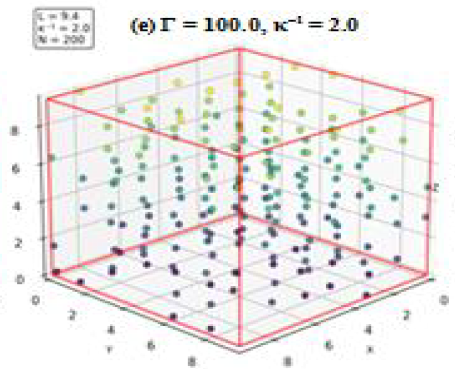
The study uses molecular dynamics simulations with LAMMPS to examine a model liquid plasma system which exhibits structural and dynamical properties of a strongly coupled Yukawa-type One-Component Plasma. The phase behavior is methodically investigated over a broad range of coupling strengths., requirements for screening bridging the gap between crystalline solids and weakly coupled gaseous plasmas. The study uses three techniques which include phase space diagrams, Mean Squared Displacement and Radial Distribution Functions to trace the changes which occur throughout the system. The results demonstrate an explicit shift from a disordered gas-like state which occurs at low coupling to a liquid state which has strong short-range order (20.0 ≤ Γ ≤100.0), and ultimately a solid-like state which has crystalline properties at extremely high coupling. The analysis method called "Structural Order vs. Coupling Strength" measures structural order through the first peak height in the RDF which shows a direct relationship with Γ as it increases. The dynamic MSD studies demonstrate that local structure development in RDFs occurs together with caged particle movement initiation while system coupling advancement leads to reduced diffusion rates. The research provides a strong computational system which scientists use to study liquid plasma systems and it enables them to identify phase transitions and study atomic-scale structures and analyze material behavior under extreme conditions. The research results provide crucial support for developing theoretical models which scientists use to study astrophysical plasma systems and inertial confinement fusion, high-energy-density physics because understanding dense plasma states requires knowledge of strongly coupled systems.
Downloads
References
Ichimaru, S. (1982). Strongly coupled plasmas: High-density classical plasmas and degenerate electron liquids. Reviews of Modern Physics, 54(4), 1017–1059. https://doi.org/10.1103/RevModPhys.54.1017
Fortov, V. E., Ivlev, A. V., Khrapak, S. A., Khrapak, A. G., & Morfill, G. E. (2005). Complex (dusty) plasmas: Current status, open issues, perspectives. Physics Reports, 421, 1–103. https://doi.org/10.1016/j.physrep.2005.08.007
Morfill, G. E., & Ivlev, A. V. (2009). Complex plasmas: An interdisciplinary research field. Reviews of Modern Physics, 81(4), 1353–1404. https://doi.org/10.1103/RevModPhys.81.1353
Brush, S. G., Sahlin, H. L., & Teller, E. (1966). Monte Carlo Study of a One‐Component Plasma. I. The Journal of Chemical Physics, 45(6), 2102–2118. https://doi.org/10.1063/1.1727895
Baus, M., & Hansen, J.-P. (1980). Statistical mechanics of simple coulomb systems. Physics Reports, 59(1), 1–94. https://doi.org/10.1016/0370-1573(80)90022-8
Robbins, Mark. O., Kremer, K., & Grest, G. S. (1988). Phase diagram and dynamics of Yukawa systems. The Journal of Chemical Physics, 88(5), 3286–3312. https://doi.org/10.1063/1.453924
Hamaguchi, S., Farouki, R. T., & Dubin, D. H. E. (1996). Phase diagram of Yukawa systems near the one‐component‐plasma limit revisited. The Journal of Chemical Physics, 105(17), 7641–7647. https://doi.org/10.1063/1.472802
Vaulina, O., Khrapak, S., & Morfill, G. (2002). Universal scaling in complex (dusty) plasmas. Physical Review E, 66(1), 016404. https://doi.org/10.1103/PhysRevE.66.016404
Hansen, J.-P., & McDonald, I. R. (2013). Theory of Simple Liquids: With Applications to Soft Matter. Academic Press.
Plimpton, S. (1995). Fast Parallel Algorithms for Short-Range Molecular Dynamics. Journal of Computational Physics, 117(1), 1–19. https://doi.org/10.1006/jcph.1995.1039
Donkó, Z., Schulze, J., Heil, B. G., & Czarnetzki, U. (2008). PIC simulations of the separate control of ion flux and energy in CCRF discharges via the electrical asymmetry effect. Journal of Physics D: Applied Physics, 42(2), 025205. https://doi.org/10.1088/0022-3727/42/2/025205
Ribeiro, M. I. (2004). Kalman and extended kalman filters: Concept, derivation and properties. Institute for Systems and Robotics, 43(46), 3736–3741. https://www.academia.edu/download/81315221/kalman.pdf
Dolai, B., & Prajapati, R. P. (2020). Effects of flow Velocity and Density of Dust Layers on the Kelvin- Helmholtz Instability in Strongly Coupled Dusty Plasma: Molecular Dynamic Study.
Neyts, E. C., & Brault, P. (2017). Molecular Dynamics Simulations for Plasma-Surface Interactions. Plasma Processes and Polymers, 14(1–2), 1600145. https://doi.org/10.1002/ppap.201600145
AlHasan, H. (2023). A Program for Generating Molecular Dynamic Simulations.
Martyna, G. J., Tobias, D. J., & Klein, M. L. (1994). Constant pressure molecular dynamics algorithms. The Journal of Chemical Physics, 101(5), 4177–4189. https://doi.org/10.1063/1.467468
Zoppi, & M, B., U. ,. (1994). Dynamics of the Liquid State | CiNii Research. https://cir.nii.ac.jp/crid/1360863107709599744
Downloads
Published
Issue
Section
License
Copyright (c) 2026 Abubakar Danyarima, Muhammad Sanusi Liman, M.S Otto, Faisal Muhammad Usman, Kamal Muhammad Gonto, Zahra Sanusi Liman (Author)

This work is licensed under a Creative Commons Attribution-ShareAlike 4.0 International License.
How to Cite