Synthesis and Characterization of Cellulose Acetate and its Derivatives from Sawdust and Corn Husk Lignocellulosic Biomass Waste
Keywords:
Cellulose acetate , Cellulose diacetate , Cellulose triacetate , Biomass valorization , Sawdust waste , Corn husk wasteAbstract
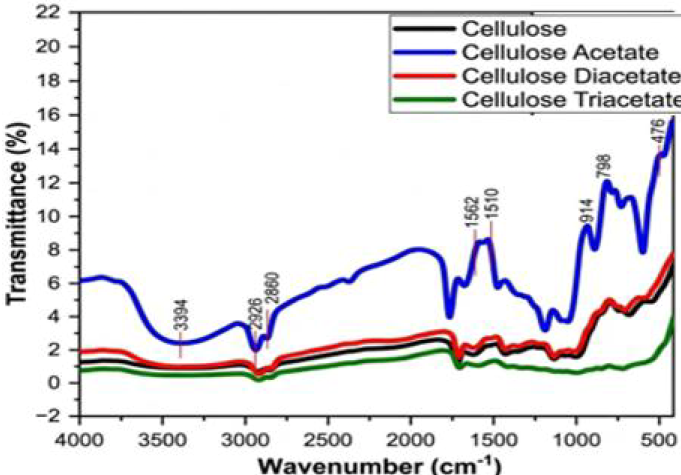
The recalcitrant nature of cellulosic biomass waste and its environmental pollution arising from incessant burning and indiscriminate dumping continue to raise global health concerns. This study investigated the synthesis and characterization of cellulose acetate derivatives from two lignocellulosic biomass waste, sawdust and corn husk waste. The work was designed to support biomass valorization of agricultural residues into cellulose esters. Sawdust and corn husk waste biomaterials underwent sequential alkaline treatment using 4 and 17.5 % sodium hydroxide, followed by oxidative bleaching to isolate alpha cellulose. The recovered cellulose was acetylated through a heterogeneous esterification route using glacial acetic acid, acetic anhydride and sulphuric acid catalyst to obtain cellulose acetate, cellulose diacetate and cellulose triacetate grades. The products were characterized by FTIR, thermogravimetric analyses and scanning electron microscopy. Sawdust produced a higher cellulose recovery of 52.3 %, compared with 48.5 % from corn husk waste, indicating its higher cellulose content and better purified pulp yield. However, corn husk waste produced higher acetate derivative yields, with cellulose acetate, cellulose diacetate, and cellulose triacetate yields of 78.0, 79.0 and 83.5 %, respectively, compared with 72.0, 76.0 and 80.0 % for sawdust. FTIR spectra confirmed acetylation through the appearance of ester carbonyl absorption around 1740-1750 cm−1, C-O stretching bands and reduced hydroxyl intensity. TGA showed improved thermal resistance of the acetate derivatives, with major degradation occurring above 250 °C and maximum degradation within the industrially relevant processing range. SEM revealed progressive transformation from fibrous cellulose to denser, film-forming acetate matrices suitable for industrial modification.
Published
How to Cite
Issue
Section
Copyright (c) 2026 Nelly Acha Ndukwe, Olufayo Olusegun Ezekiel, Nathanael Ilesanmi (Author)

This work is licensed under a Creative Commons Attribution-ShareAlike 4.0 International License.
How to Cite
Similar Articles
- Nelly Ndukwe, O. O. Adegboyebo, M. R. Maloma, Wesley Okiei, Production of Cellulose from Different Species of Banana (Musa paradisiaca) Mid-Rib Waste: A Sustainable Raw Material for Industrial Applications , Lafia Journal of Scientific and Industrial Research: Volume 4, Issue 2 (October, 2026), Lafia Journal of Scientific and Industrial Research (LJSIR) [IN PROGRESS]
- Abdulkarim Muhammad Hamza, Ahmed Abdullahi Sule, Umar Sa'ad Aliyu, Atanyi Yusuf, Sani Muhammad, Mustapha Adejo Muhammad , Adejo Andrew Ojonugwa, Hassan Shaibatu Ibrahim, Extraction, Prototype Design for the Process Automation of Pure Amorphous Silica from Rice Milling Waste (Husk) , Lafia Journal of Scientific and Industrial Research: Volume 4, Issue 1 (April, 2026), Lafia Journal of Scientific and Industrial Research (LJSIR)
- Oludare Agboola, Evangeline Abah, Samuel Ijimbili, Oche Andrew, Irene Unazi, Audud Onyemocho, Adelanwa E., Assessment of Waste Management Practices among Residents of Benue South , Lafia Journal of Scientific and Industrial Research: Volume 2, Issue 1 (April, 2024), Lafia Journal of Scientific and Industrial Research (LJSIR)
- Saadatu Balarabe Aliyu , Matthew Olaleke Aremu, Jude Chinedu Onwuka, David Bala Passali, Nutritive and Antinutritive Values of Fermented Guinea Corn (Sorghum bicolor L.) Fortified with Bambara Groundnut (Vigna subterranea L.) Flour , Lafia Journal of Scientific and Industrial Research: Volume 1, Issue 1 & 2 (October, 2023), Lafia Journal of Scientific and Industrial Research (LJSIR)
- Okponmwense Moses, Omoye Shelah Omonzejie, Lawrence Ojong Ndip, Effect of Magnesium Oxide-Carbonized Hibiscus Sabdariffa (Zobo) Waste and Magnesium–Zinc Binary Oxide Nanocomposites in Mitigating Cadmium and Bacteria in Contaminated Water. , Lafia Journal of Scientific and Industrial Research: Volume 3, Issue 1 (April, 2025), Lafia Journal of Scientific and Industrial Research (LJSIR)
- C. B. Okpanachi, C. C. Onoyima, L. Ekwoba, R. Larayetan, E. M. Ameh, E. Abalaka, E. Ejukwa, Multi-Index Ecological Risk Evaluation of Heavy Metal Contamination in Agricultural Soils Influenced by Auto-Mechanic Activities in Anyigba, Nigeria , Lafia Journal of Scientific and Industrial Research: Volume 4, Issue 1 (April, 2026), Lafia Journal of Scientific and Industrial Research (LJSIR)
- Osuegba Osuendo Solomon, U. Adamu, S. Mamman, O. B. Aduke, S. Yusuf, D. P. Habila, B. M. Nathaniel, K. H. Uzeru, Investigation on the Mechanical Properties of Luffa (Luffa cylindrica) and Banana (Musa acuminata) Fibre Reinforced Recycled Low-Density Polyethylene (rLDPE) , Lafia Journal of Scientific and Industrial Research: Volume 3, Issue 2 (October, 2025), Lafia Journal of Scientific and Industrial Research (LJSIR)
- Shaibatu Ibrahim Hassan, Sani Umar Muhammad , Olumide Oluwasanmi Ige, Synthesis, Compositional, Morphological, Structural, and Thermal Properties of Eggshell Calcium Oxide for Solar Photovoltaic Glass , Lafia Journal of Scientific and Industrial Research: Volume 3, Issue 2 (October, 2025), Lafia Journal of Scientific and Industrial Research (LJSIR)
- Ezike E. C., Omeche J., Onyeabor C. F. , Akinola S. A., Evaluating the Geochemical Properties of Awhum Coal and its Potential for Sustainable Energy Generation and Optimization in Nigeria , Lafia Journal of Scientific and Industrial Research: Volume 3, Issue 1 (April, 2025), Lafia Journal of Scientific and Industrial Research (LJSIR)
- Umar Saad Aliyu, Ibrahim Gana Geidam, Abdulkarim Muhammad Hamza, Sani Muhammad, Mustapha Adejo Muhammad, Hassan Shaibatu Ibrahim, Mustapha Bukar Liberty, Bismuth Doped Soda Lime Silica Borate (SLS–B2O3–Bi2O3) Glasses forGamma Radiation Shielding Application , Lafia Journal of Scientific and Industrial Research: Volume 4, Issue 2 (October, 2026), Lafia Journal of Scientific and Industrial Research (LJSIR) [IN PROGRESS]
You may also start an advanced similarity search for this article.