Bismuth Doped Soda Lime Silica Borate (SLS–B2O3–Bi2O3) Glasses forGamma Radiation Shielding Application

Authors

  • Umar Saad Aliyu
    Department of Physics, Faculty of Physical Sciences, Federal University of Lafia
    Muhammadu Buhari TETFund Center of Excellence, Federal University of Lafia, Nasarawa State, Nigeria
  • Ibrahim Gana Geidam
    Department of Physics, Yobe State University Damaturu, Nigeria
  • Abdulkarim Muhammad Hamza
    Department of Physics, Federal University of Lafia, Nasarawa State, Nigeria
  • Sani Muhammad
    Department of Physics, Federal University of Lafia, Nasarawa State, Nigeria
  • Mustapha Adejo Muhammad
    Department of Physics, Federal University of Lafia, Nasarawa State, Nigeria
  • Hassan Shaibatu Ibrahim
    National Agency for Science and Engineering Infrastructure, Idu, Abuja, Nigeria
  • Mustapha Bukar Liberty
    Department of Physics, Kashim Ibrahim University, Maiduguri, Borno State, Nigeria

Keywords:

Borate Glasses , Soda Lime Silicate (SLS) Glasses , Radiation Shielding Glasses

Abstract

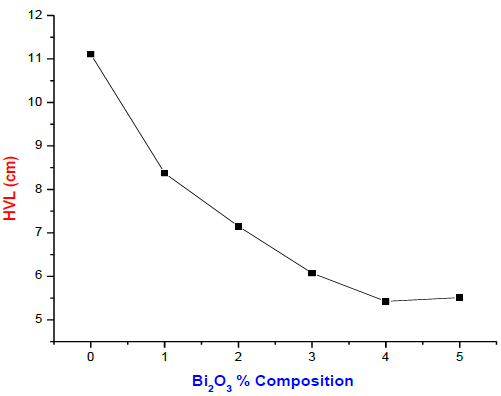
In this research, local content of glass waste, pure powdered boron oxide and bismuth oxide as starting materials were utilized for fabrication of glasses. These glasses will serve as safer substitutes to lead blocks/lead glasses and concretes in radiation shielding in industries, research institutes and medical diagnostic centers. The main objective of this work is to study the physical, structural and radiation shielding properties of the glasses. For the glass fabrication, a conventional melt-quenching technique and chemical compositional formula 50SLS-50B2O3- (100-x) Bi2O3, where x = 0, 1, 2, 3, 4, 5 wt% were utilized. Various measurements and characterizations such as density measurement and X-ray diffraction (XRD) were carried out to study the structural and physical properties of the glasses. The gamma shielding measurements were carried out using NaI (TI) detector gamma spectrometer using a Cs-137 radioactive element source with photon energy 0.662 MeV. The density value increased from 2.264847 gcm-3 to 2.401604 gcm-3. The XRD spectral pattern showed the amorphous nature of the glasses. The LAC and MAC values ranged between 0.0624 cm-1 to 0.1277 cm-1 and 0.0276 cm2/g to 0.0532 cm2/g. Other gamma radiation shielding efficiency parameters studied include Half Value Layers (HVL), Mean Free Path (MFP), Tenth Value Layer (TVL), Permeability Factor (PF) and Radiation Protection Efficiency (RPE).
Dimensions

[1] I. G. Geidam et al., “Oxide ion polarizabilities and gamma radiation shielding features of TeO 2 – B 2 O 3 – SiO 2 glasses containing Bi 2 O 3 using Phy-X / PSD software,” Mater. Today Commun., vol. 31, no. April, pp. 1–9, 2022.

[2] R. El-Mallawany, M. I. Sayyed, and M. G. Dong, “Comparative shielding properties of some tellurite glasses: Part 2,” J. Non. Cryst. Solids, vol. 474, no. August, pp. 16–23, 2017, doi: 10.1016/j.jnoncrysol.2017.08.011.

[3] M. I. Sayyed, H. O. Tekin, O. Kılıcoglu, O. Agar, and M. H. M. Zaid, “Shielding features of concrete types containing sepiolite mineral: Comprehensive study on experimental, XCOM and MCNPX results,” Results Phys., vol. 11, pp. 40–45, 2018, doi: 10.1016/j.rinp.2018.08.029.

[4] A. B. Azeez, K. S. Mohammed, A. M. M. Al Bakri, H. I. Hasan, and O. A. Abdulkareem, “Radiation shielding characteristics of concretes incorporates different particle sizes of various waste materials,” Adv. Mater. Res., vol. 925, no. April 2014, pp. 190–194, 2014, doi: 10.4028/www.scientific.net/AMR.925.190.

[5] M. Mahmoud, S. A. Makhlouf, B. Alshahrani, H. A. Yakout, K. S. Shaaban, and E. A. A. Wahab, “Experimental and Simulation Investigations of Mechanical Properties and Gamma Radiation Shielding of Lithium Cadmium Gadolinium Silicate Glasses Doped Erbium Ions,” Silicon, pp. 1–15, 2021.

[6] Y. B. Saddeek, S. A. M. Issa, T. Alharbi, K. Aly, M. Ahmad, and H. O. Tekin, “Mechanical and nuclear shielding properties of sodium cadmium borate glasses : Impact of cadmium oxide additive,” Ceram. Int., vol. 46, no. 3, pp. 2661–2669, 2020, doi: 10.1016/j.ceramint.2019.09.254.

[7] A. M. Vadavathi, S. K. Chinthakayala, V. S. Kollipara, G. Ramadurai, and P. Gadige, “Physical properties and gamma radiation shielding capability of highly dense binary bismuth borate glasses,” Ceram. Int., vol. 47, no. 7PA, pp. 9791–9805, 2021, doi: 10.1016/j.ceramint.2020.12.120.

[8] E. Zorla et al., “Radiation shielding properties of high performance concrete reinforced with basalt fibers infused with natural and enriched boron,” Nucl. Eng. Des., vol. 313, pp. 306–318, 2017, doi: 10.1016/j.nucengdes.2016.12.029.

[9] Y. S. Alajerami et al., “Radiation shielding properties of bismuth borate glasses doped with different concentrations of cadmium oxides,” Ceram. Int., vol. 46, no. 8, pp. 12718–12726, 2020, doi: 10.1016/j.ceramint.2020.02.039.

[10] A. Azuraida et al., “GAMMA RAY SHIELDING PARAMETER OF BARIUM-BORO-TELLURITE GLASS,” Chalcogenide Lett., vol. 17, no. 4, pp. 187–196, 2020.

[11] K. M. Kaky et al., “Combined experimental and Geant4 Monte Carlo study of radiation shielding investigation of TeO 2 -B 2 O 3 -ZnO-BaO-Bi 2 O 3 -PbO transparent glass-ceramic composition,” Chem. Phys. Impact, vol. 12, no. March, p. 101065, 2026, doi: 10.1016/j.chphi.2026.101065.

[12] R. Elsaman, H. H. Somaily, and H. Algarni, “Mechanical, physical and gamma ray shielding properties of xPbO-(50-x) MoO3–50V2O5 (25 ≤ x ≤ 45 mol %) glass system,” Ceram. Int., vol. 46, no. 12, pp. 20251–20263, 2020, doi: 10.1016/j.ceramint.2020.05.107.

[13] K. R. M. Abdelgawad, H. A. Saleh, R. L. Elwan, A. M. Fayad, and R. M. Ahmed, “Optical properties and multi-radiation shielding performance of cement dust incorporated bismuth-vanadium-borate glasses,” Nucl. Eng. Technol., vol. 58, no. 10, p. 104416, 2026, doi: 10.1016/j.net.2026.104416.

[14] S. Bhavya et al., “Effect of glass composition on physical , mechanical and radiation shielding performance of Barium Bismuth Boro-tellurite glasses,” Results Phys., vol. 81, no. January, 2026.

[15] S. Alomairy, C. Mutuwong, I. Boukhris, I. O. Olarinoye, and B. T. Tonguc, “Effect of Nd 3 + ions on radiation attenuation properties of PbF 2 – TeO 2 – WO 3 glass system for,” Boletín La Soc. Española cerámica y Vidr., no. 2020, pp. 1–17, 2021, doi: 10.1016/j.bsecv.2021.03.005.

[16] M. S. Al-Buriahi, M. I. Sayyed, and Y. Al-Hadeethi, “Role of TeO2 in radiation shielding characteristics of calcium boro-tellurite glasses,” Ceram. Int., vol. 46, no. 9, pp. 13622–13629, 2020, doi: 10.1016/j.ceramint.2020.02.148.

[17] S. A. Umar et al., “Optical and structural properties of rice husk silicate incorporated borotellurite glasses doped with erbium oxide nanoparticles,” J. Mater. Sci. Mater. Electron., vol. 30, no. 2019, pp. 18606–18616, 2019, doi: 10.1007/s10854-019-02213-z.

[18] S. H. Alazoumi et al., “Optical properties of zinc lead tellurite glasses,” Results Phys., vol. 9, no. March, pp. 1371–1376, 2018, doi: 10.1016/j.rinp.2018.04.041.

[19] S. A. Umar, M. K. Halimah, A. M. Hamza, and A. A. Abdulbaset, “The Structural , Physical and Optical Properties of Borotellurite Glasses Incorporated with Silica from Rice Husk,” J. Sci. Math. Lett., vol. 6, no. 2018, pp. 32–46, 2018.

[20] S. Thakur et al., “Thermo- and photoluminescent properties and gamma radiation shielding efficiency of NiO doped B2O3–Bi2O3 glass system,” Radiat. Phys. Chem., no. xxxx, 2023.

[21] M. K. Halimah, A. A. Awshah, A. M. Hamza, S. A. Umar, K. T. Chan, and S. H. Alazoumi, “Effect of neodymium nanoparticles on optical properties of zinc tellurite glass system,” J. Mater. Sci. Mater. Electron., vol. 31, no. 2020, pp. 3785–3794, 2020, doi: 10.1007/s10854-020-02907-9.

[22] S. H. Alazoumi et al., “Structural, elastic, thermo-physical and gamma radiation shielding efficiency of MnO2 doped TeO2-PbO-ZnO glasses,” Opt. Mater. (Amst)., vol. 150, no. January, p. 115277, 2024, doi: 10.1016/j.optmat.2024.115277.

[23] A. S. Aliyu et al., “Optoelectronic and Gamma Ray Attenuation Properties of Ore-based Bi and Sn-doped Borosilicate Glasses,” Ceram. Int., vol. 50, no. 15, pp. 26424–26434, 2024, doi: 10.1016/j.ceramint.2024.04.369.

[24] I. G. Geidam et al., “Thermo-physical and elastic properties of Bi2O3 doped silica borotellurite glasses,” Optik (Stuttg)., vol. 248, no. 2021, pp. 12–15, 2021, doi: 10.1016/j.ijleo.2021.168201.

[25] H. R. Shaari et al., “Oxide ion polarizability , optical basicity , and metallization criterion of GO-coated Nd 2 O 3 ( NPs ) - TeO 2 glass for linear optical fibre,” Chalcogenide Lett., vol. 19, no. 8, pp. 565–577, 2022.

[26] M. N. Azlan, M. K. Halimah, A. B. Suriani, Y. Azlina, S. A. Umar, and R. El-mallawany, “Upconversion properties of erbium nanoparticles doped tellurite glasses for high efficient laser glass,” Opt. Commun., vol. 448, no. April, pp. 82–88, 2019, doi: 10.1016/j.optcom.2019.05.022.

[27] A. S. Aliyu et al., “Bismuthite and cassiterite-doped borosilicate glass systems for X-rays attenuation : Fabrication and characterisation,” Opt. Mater. (Amst)., vol. 151, no. April, p. 115365, 2024, doi: 10.1016/j.optmat.2024.115365.

[28] M. Y. Hanfi, S. A. M. Issa, C. V More, and M. I. Sayyed, “Experimental assessment of gamma-ray attenuation features of BaO-CaO-enriched borate glasses as lead-free radiation shielding materials,” Nucl. Eng. Technol., vol. 58, no. March, 2026.

[29] L. S. Rao, “Modifier effect of BaTiO 3 nanoparticles on morphology , structural , and radiation shielding characteristics of Li 2 O – BaTiO 3 – B 2 O 3 : TiO 2 glasses,” Nucl. Eng. Technol., vol. 58, no. June 2025, 2026, doi: 10.1016/j.net.2025.103905.

[30] M. I. Sayyed, M. W. Marashdeh, A. Kumar, and S. Yasmin, “Tailoring the structural and functional properties of B 2 O 3 -PbO 2 -BaO-CaO-Sm 2 O 3 glass system for potential radiation shielding applications,” J. Sci. Adv. Mater. Devices, vol. 11, no. 1, p. 101082, 2026, doi: 10.1016/j.jsamd.2025.101082.

[31] H. Deng et al., “Structure – property relationships in Bi 2 O 3 – TiO 2 – B 2 O 3 glasses modified with BaO : toward lead – free radiation shielding materials,” Ceram. Int., vol. 51, no. 30PA, pp. 63427–63440, 2025, doi: 10.1016/j.ceramint.2025.11.129.

[32] S. Mukamil et al., “Lead-borate glass system doped with Sm3+ ions for the X-ray shielding applications,” Results Phys., vol. 43, no. November, p. 106121, 2022, doi: 10.1016/j.rinp.2022.106121.

[33] A. M. Onaizi et al., “Radiation-shielding concrete: A review of materials, performance, and the impact of radiation on concrete properties,” J. Build. Eng., vol. 97, no. September, p. 110800, 2024, doi: 10.1016/j.jobe.2024.110800.

[34] M. I. Sayyed, A. Alshamari, and M. H. A. Mhareb, “Roles of ZnO and La 2 O 3 in enhancing the mechanical , optical , and radiation shielding properties of B2O3 -Bi2O3 -Na2O transparent glasses,” J. Radiat. Res. Appl. Sci., vol. 18, no. 4, p. 101859, 2025, doi: 10.1016/j.jrras.2025.101859.

[35] I. Kebaili, I. Boukhris, M. S. Al-buriahi, A. Alalawi, and M. I. Sayyed, “Ge-Se-Sb-Ag chalcogenide glasses for nuclear radiation shielding applications,” Ceram. Int., vol. 47, no. 1, pp. 1303–1309, 2021, doi: 10.1016/j.ceramint.2020.08.251.

[36] Y. S. Rammah, E. Kavaz, F. I. El Agawany, H. O. Tekin, and U. Peris, “Nuclear radiation shielding using barium borosilicate glass ceramics,” J. Phys. Chem. Solids, vol. 142, no. December 2019, 2020, doi: 10.1016/j.jpcs.2020.109437.

[37] A. H. Almuqrin and M. I. Sayyed, “Radiation shielding characterizations and investigation of TeO2–WO3–Bi2O3 and TeO2–WO3–PbO glasses,” Appl. Phys. A Mater. Sci. Process., vol. 127, no. 3, pp. 1–11, 2021, doi: 10.1007/s00339-021-04344-9.

[38] M. A. Al-jubbori and M. Taha, “Efficiency of radiation shielding for types automotive glass in the market Iraq : Experimental and theoretical study,” Next Mater., vol. 12, no. December 2025, p. 102155, 2026, doi: 10.1016/j.nxmate.2026.102155.

cover

Published

2026-09-16

How to Cite

Bismuth Doped Soda Lime Silica Borate (SLS–B2O3–Bi2O3) Glasses forGamma Radiation Shielding Application. (2026). Lafia Journal of Scientific and Industrial Research, 4(2), 131-138. https://doi.org/10.62050/ljsir2026.v4n2.911

How to Cite

Bismuth Doped Soda Lime Silica Borate (SLS–B2O3–Bi2O3) Glasses forGamma Radiation Shielding Application. (2026). Lafia Journal of Scientific and Industrial Research, 4(2), 131-138. https://doi.org/10.62050/ljsir2026.v4n2.911

Similar Articles

You may also start an advanced similarity search for this article.