
A MATHEMATICAL MODELING OF THE DYNAMICS OF TYPHOID FEVER
Keywords:
sensitivity analysis , basic reproduction number , Equilibrium pointAbstract
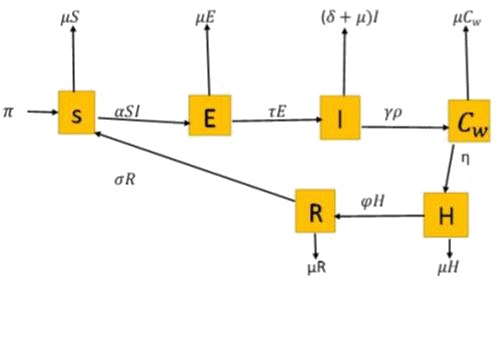
A comprehensive mathematical model of typhoid fever was developed to investigate the complex transmission dynamics of the disease, shedding light on the intricate relationships between various factors influencing its spread. The model assumes a replenished population through birth and leverages existing data to validate its accuracy, ensuring a reliable representation of the disease’s behavior. The primary objective of this modeling exercise is to inform and enhance strategies for preventing, controlling, and eradicating typhoid fever, ultimately leading to improved public health policy and a better quality of life. Through mathematical analysis, it was revealed that the basic reproductive number ????0 plays a crucial role in determining the global dynamics of the disease. ????0 is less than 1, the disease-free equilibrium is locally stable, indicating that the disease will eventually die out. Conversely, if ????0 exceeds 1, an endemic equilibrium exists, and the disease will persist at a stable level. A thorough sensitivity analysis of the model parameters was conducted, providing valuable insights into the impact of various factors on the spread of typhoid fever. This knowledge enables informed decision-making and effective disease management. The model was solved using the Runge-Kutta scheme of order four, with a 40-year time horizon, and implemented in MATLAB. This study showcases the potency of mathematical modeling in understanding the transmission dynamics of typhoid fever, enabling policymakers and healthcare professionals to develop evidence-based strategies for disease control and prevention.
Published
How to Cite
Issue
Section
How to Cite
Most read articles by the same author(s)
- Hassan Ibrahim, Mbai Nannim Lohnap, Atanyi Yusuf Emmanuel, DISTANCE-BASED TOPOLOGICAL INDICES OF THE MOLECULARSTRUCTURE OF SOME DRUGS FOR TREATING CANCER PATIENTS , FULafia Journal of Science and Technology : Vol. 10 No. 1 (2026): Fulafia Journal of Science and Technology (FJST)
Similar Articles
- Somma S. A., Akinwande N. I., SENSITIVITY ANALYSIS FOR THE MATHEMATICAL MODELLING OF MONKEY POX VIRUS INCORPORATING QUARANTINE AND PUBLIC ENLIGHTENMENT CAMPAIGN , FULafia Journal of Science and Technology : Vol. 6 No. 1 (2020): Fulafia Journal of Science and Technology (FJST)
- Usman Mohammed Yusuf, Dr. Akpan C. E., Dr. Saleh I. M., Yalwa M. M., Enoch B. T., Mathematical Modeling of the Spread of the Ebola Virus Disease , FULafia Journal of Science and Technology : Vol. 8 No. 2 (September, 2024): Fulafia Journal of Science and Technology (FJST)
- Godwin Ma’aji, Collins Emmanuel Akpan , Moses Anayo Mbah, MODELING CHOLERA DYNAMICS WITH VACCINATION AND ASYMPTOMATIC TRANSMISSION: A MATHEMATICAL FRAMEWORK FOR OUTBREAK CONTROL , FULafia Journal of Science and Technology : Vol. 10 No. 1 (2026): Fulafia Journal of Science and Technology (FJST)
- Kana H. A., Kana H. A., Kwon-Ndung E. H., CORRELATION AND PATH COEFFICIENT ANALYSIS OF SOME GROWTH AND YIELD CONTRIBUTING TRAITS IN COWPEA (VIGNA UNGUICULATA (L) WALP.) EXPOSED TO ALPHA-SPIN NANO PARTICLES , FULafia Journal of Science and Technology : Vol. 5 No. 2 (2019): Fulafia Journal of Science and Technology (FJST)
- Angyu A. E., Garjila Y., Madi B. D., GROWTH AND YIELD RESPONSES OF SOYA BEAN (Glycine max L.) TO VARYING SPACING IN JALINGO, TARABA STATE , FULafia Journal of Science and Technology : Vol. 3 No. 2 (2017): Fulafia Journal of Science and Technology (FJST)
- Goler E. E., Namo O. A. T., Mwanja Y. P., METRIC ASSOCIATIONS AND PATH ANALYSIS IN SWEET POTATO ( Ipomoea batatas (L.) Lam.) IN JOS-PLATEAU NIGERIA , FULafia Journal of Science and Technology : Vol. 3 No. 1 (2017): Fulafia Journal of Science and Technology (FJST)
- Godwin Omame Ogah, Ambo Idzi Amos, Hauwa Ahmad Kana, IMPACT OF ALPHA SPIN NANOPARTICLES ON GENETIC DIVERSITY OFNIGERIA SESAME (Sesamum indicum L.) GERMPLASM , FULafia Journal of Science and Technology : Vol. 9 No. 2 (2025): Fulafia Journal of Science and Technology (FJST) (In Progress)
- Mr. Lucky Peter Kenda, Adetola Sunday Oniku, Bello Yusuf Idi, Dr. Yohanna Andarawus, Sebastian Abraham Sunu, AEROMAGNETIC SPECTRAL INVESTIGATION OF SUBSURFACE THERMAL STRUCTURE FOR GEOTHERMAL ENERGY EVALUATION IN YOLA ARM, UPPER BENUE TROUGH, NIGERIA , FULafia Journal of Science and Technology : Vol. 10 No. 2 (2026): Fulafia Journal of Science and Technology (FJST)
- Kumurya A. S., Dogo E. B., Abdulkadir G., Compa rative study of semen pa rameters between manual and sperm quality analyzer techniques among infertile patients in Kano, Nigeria , FULafia Journal of Science and Technology : Vol. 5 No. 1 (2019): Fulafia Journal of Science and Technology (FJST)
- Yusuf Mohammed Ibrahim, Godwin Ogah, Kana Hauwa Ahmad, Hanah Eyo Nsemoh, Okposhi Isah Ibrahim, Zainab Alhassan, Jibril Lawal Imam, DETERMINATION OF TRAITS ASSOCIATION AND CONTRIBUTION AMONG AGRONOMIC AND SEED OIL TRAITS OF SESAME (Sesamum indicum L.) GENOTYPES EVALUATED IN LAFIA METROPOLIS, NASARAWA STATE, NIGERIA , FULafia Journal of Science and Technology : Vol. 10 No. 1 (2026): Fulafia Journal of Science and Technology (FJST)
You may also start an advanced similarity search for this article.