Characterization of Fungal Contaminants in Fermented Locust Beans in Kwara State: Implications for Food Safety
Keywords:
Array, Array, Array, Array, ArrayAbstract
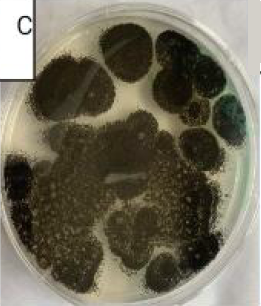
Fermented locust bean seeds are utilized for seasoning in various traditional dishes. Its production is mostly under unhygienic conditions by majorly illiterate women who care less about microbial contamination of the final product. Consumption of any contaminated food can cause health complications in humans. DNA extraction offers a distinct method for identifying organisms. This study aimed at isolating the mycoflora associated with fermented locust bean seeds collected from 3 villages in Kwara State, Nigeria using both morphological and molecular techniques. Morphologically, isolate A was yellowish – green, B was black; C was initially white, but turned to brown later, while D was cottony and white in colour. DNA of each of the isolates was extracted using Zymo Fungal/Bacteria DNA Miniprep Kit. PCR amplification of the ITS regions of the isolates was carried out using primer pair; ITS1 and ITS4. The products were then sequenced and the results after BLAST search revealed that Isolate A is Aspergillus flavus, B is A. niger, C is Rhizopus arrhizus and D is Mucor indicus. The fermented locust bean seeds from Madi village had the highest fungal count (7.2 X 10³ cfu/ml), while that from Ogundele village had the lowest (1.4 X 10³ cfu/ml). The presence of Aspergillus niger and A. flavus (mycotoxigenic fungi) in this study poses a significant public health risk. Therefore, it is important to encourage the villagers involved in fermented locust bean production and storage in these villages to be more hygienic.
Published
How to Cite
Issue
Section
Copyright (c) 2024 Lafia Journal of Scientific and Industrial Research

This work is licensed under a Creative Commons Attribution-NonCommercial-ShareAlike 4.0 International License.
How to Cite
Similar Articles
- Ayorinde O. Nejo, Ademola J. Adetona, Adetoun Lawal, Green Synthesis of Nickel Oxide Nanoparticles and its Application in the Degradation of Methyl Red , Lafia Journal of Scientific and Industrial Research: Volume 2, Issue 2 (October, 2024), Lafia Journal of Scientific and Industrial Research (LJSIR)
- Alexander Ezekiel Angyu, Emmanuel H. Kwon-Ndung, Alpha-Spin-Mediated Growth Factors Improvement for Tomato (Lycopersicon esculentum Mill.) Varieties in Jauro Yinu, Ardo-Kola LGA, Taraba State , Lafia Journal of Scientific and Industrial Research: Volume 2, Issue 2 (October, 2024), Lafia Journal of Scientific and Industrial Research (LJSIR)
- C. O. Iyamu, L. W. Lumbi, Ibrahim Inusa Ewa, E. V. Tikyaa, Dynamical System Analysis of Reference Evapotranspiration using Chaos Models in Some Selected States in Northern Nigeria , Lafia Journal of Scientific and Industrial Research: Volume 2, Issue 2 (October, 2024), Lafia Journal of Scientific and Industrial Research (LJSIR)
- Oladiran Johnson Abimbola, Taiwo Adewumi, Hauwa Onyeka Iyima, Fidelis Iorzua Kwaghhua, Thermal and Structural Analysis of Airborne Magnetic Data of part of Nasarawa State, Nigeria: Implication for Geothermal Energy Exploration , Lafia Journal of Scientific and Industrial Research: Volume 2, Issue 2 (October, 2024), Lafia Journal of Scientific and Industrial Research (LJSIR)
- C. O. Iyamu, Ibrahim Inusa Ewa, L. W. Lumbi, Estimation of Reference Evapotranspiration Using Penman-Monteith Equation and Time Series Model in some Selected States in Northern Nigeria , Lafia Journal of Scientific and Industrial Research: Volume 2, Issue 2 (October, 2024), Lafia Journal of Scientific and Industrial Research (LJSIR)
- Adogo L. Y., Julia K. M., Joshua P. D., Occurrence and Antifungal Susceptibility of Candida Species Isolated from Pregnant Women in a Tertiary Hospital , Lafia Journal of Scientific and Industrial Research: Volume 1, Issue 1 & 2 (October, 2023), Lafia Journal of Scientific and Industrial Research (LJSIR)
You may also start an advanced similarity search for this article.