Levels and Health Risk Assessment of Heavy Metals in Selected Skin-Whitening Creams Marketed in Lafia Town

Authors

  • Augustine Uche Abel
    Department of Chemistry, Federal University of Lafia, PMB 146, Nasarawa State, Nigeria
  • Muhammad Sa'id Abubakar
    Department of Chemistry, Federal University of Lafia, PMB 146, Nasarawa State, Nigeria
  • Hamza Ibrahim Muhammad
    Department of Chemistry, Federal University of Lafia, PMB 146, Nasarawa State, Nigeria

Keywords:

Accumulation , Contamination , Cosmetics , Hazardous , Heavy metal , Safe limit

Abstract

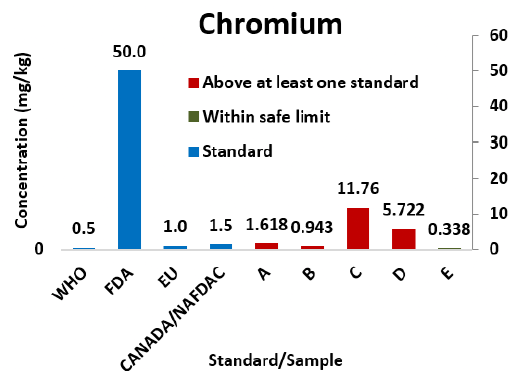
The rising popularity of skin-whitening creams in Nigeria raises alarms about potential exposure to harmful metals that may occur either as impurities or as intentionally added ingredients. This study assessed the levels of cadmium, chromium, copper, iron, and lead in various skin-whitening creams available in Lafia Town. Samples from different brands were randomly collected from shops in Lafia Modern Market, pre-treated through acid digestion, and analyzed using Atomic Absorption Spectroscopy (AAS). The findings indicated diverse concentrations of metals across the creams, which were compared with six international standards. Pb, Cr, and Cd were found exceeding the recommended limits of one or more international standards, in at least one of the tested brands. The trend of metal concentrations was recorded as: Cr>Fe>Pb>Cd>Cu. However, there was no statistically significant difference in total metal concentrations across the samples (p = 0.749). Apart from the fear of gradual environmental toxicity, health risk assessments suggested that prolonged use of these products could eventually cause adverse health effects such as dermatitis, kidney toxicity, and cancer risk, since the TCR and HI values for all the samples (A–E) were above the safety zones, posing both carcinogenic and non-carcinogenic risks. The HQs and LCRs indicated Cr as the major contributor to those threats. Hence, there is a critical need for regulatory measures, quality assurance in manufacturing, and regular monitoring of cosmetic items in Lafia. Furthermore, an increased effort in consumer education initiatives is required to deter the use of harmful skin-whitening creams and advocate for safer alternatives.
Dimensions

1. Draelos Z. D. (2015). Cosmetics: The Medicine of Beauty. Journal of Cosmetic Dermatology, Vol. 14, Issue 2, pg. 91-171. https://doi.org/10.1111/jocd.12146.

2. Pillaiyar, T., Manickam, M., & Namasivayam, V. (2017). Skin-whitening agents: Medicinal chemistry perspective of tyrosinase inhibitors. Journal of enzyme inhibition and medicinal chemistry, 32(1), 403-425.https://doi.org/10.1080/14756366.2016.1256882.

3. Desmedt, B., Courselle, P., De Beer, J. O., Rogiers, V., Grosber, M., Deconinck, E., & De Paepe, K. (2016). Overview of skin-whitening agents with an insight into the illegal cosmetic market in Europe. Journal of the European Academy of Dermatology and Venereology, 30(6), 943-950. https://doi.org/10.1111/jdv.13595.

4. Glenn E. N. (2008). Yearning for Lightness: Transnational Circuits in the Marketing and Consumption of Skin Lighteners. Sage Journals,Vol.22, Issue 3. https://doi.org/10.1177/0891243208316089.

5. Statista. (2021). Skin-lightening products market worldwide 2020–2027.

6. Mgbemena, N. M., Ilechukw, I., Akoh, O. U., & Adinnu, A. C. (2024). Risk assessment of heavy metals in some commonly used cosmetics in rivers state nigeria. Journal of Chemical Society of Nigeria, 49(3). https://doi.org/10.46602/jcsn.v49i3.98.

7. Iwegbue, C. M.A., Bassey, F. I., Obi, G., Tesi, G. O., & Martincigh, B. S. (2016). Concentrations and exposure risks of some metals in facial cosmetics in Nigeria. Toxicology reports, 3, 464-472. https://doi.org/10.1016/j.toxrep.2016.04.004.

8. Nagajyoti, P. C., Lee, K. D., & Sreekanth, T. V. M. (2010). Heavy metals, occurrence, and toxicity for plants: A review. Environmental Chemistry Letters, 8(3), 199–216. https://doi.org/10.1007/s10311-010-0297-8.

9. Bocca, B., Pino, A., Alimonti, A., and Forte, G. (2014). Toxic metals contained in cosmetics: A status report. Regulatory Toxicology and Pharmacology,Vol. 68, Issue 3, Pages 447-46. https://doi.org/10.1016/j.yrtph.2014.02.003.

10. Gaetke L.M., and Chow, C.K. (2003). Copper toxicity, oxidative stress, and antioxidant nutrients. Toxicology, 189(1-2):147-63. doi: 10.1016/s0300-483x(03)00159-8.

11. World Health Organization (WHO). (2010). Exposure to cadmium: A major public health concern. WHO Press.

12. Nohynek, G. J., Antignac, E., Re, T., & Toutain, H. (2010). Safety assessment of personal care products/cosmetics and their ingredients. Toxicology and Applied Pharmacology, 243(2), 239–259.DOI: 10.1016/j.taap.2009.12.001.

13. Manu, J. M., Norah, S., Vincent, F., & Francis, S. (2023). Levels of Cd, Cr, Cu, Ni, Zn, As and Pb in Some Cosmetic Products in Jimeta-Yola Modern Market, Adamawa State, Nigeria. Journal of Applied Sciences & Environmental Management, 27(8), 1739. doi.10.4314/jasem.v27i8.18.

14. Santhosh, K., Kamala, K., Ramasamy, P., Musthafa, M. S., Almujri, S. S., Asdaq, S. M. B., & Sivaperumal, P. (2024). Unveilingthe silent threat: Heavy metal toxicity devastating impact on aquatic organisms and DNA damage. Marine Pollution Bulletin, 200, 116139. DOI: 10.1016/j.marpolbul.2024.116139.

15. Attard, T., & Attard, E. (2022). Heavy Metals in Cosmetics. In Environmental Impact and Remediation of Heavy Metals. IntechOpen. https://doi.org/10.5772/intechopen.102406.

16. Al-Saleh, I., Al-Enazi, S., &Shinwari, N. (2009). Assessment of lead in cosmetics products. Regulatory Toxicology and Pharmacology, 54(2), 105–13.doi: 10.1016/j.yrtph.2009.02.005. Epub 2009 Feb 27.

17. Akiibinu, M. O., Bob Soile, O., Akinade, L. E., & Akiibinu, S. O. (2019). Levels of Toxic Metals in Skin Lightening Agents Commonly Used in Lagos, Nigeria. Journal of Advances in Chemistry. https://doi.org/10.24297/jac.v16i0.8317.

18. Agency for Toxic Substances and Disease Registry. (2020). Toxicology Profile of Lead. The Public Health Service, or the U.S. Department of Health and Human Services,https://www.atsdr.cdc.gov/toxprofiles/tp13.pdf.

19. International Agency for Research on Cancer (IARC). (2012). Arsenic, metals, fibres, and dusts: IARC monographs on the evaluation of carcinogenic risks to humans (Vol. 100C). WHO Press.

20. Emenike, E. C., Iwuozor, K. O., Olayinka, S. K., Taiye, O.O., Okwor, U. D., Okiy, K. V, & Adeniyi, A. G. (2026). Toxic metals in Cosmetic and Personal Care Products: Occurrence, Concentrations, and Health Risks. Biological Trace Element Research, 1-19. https://doi.org/10.1007/s12011-026-05220-4.

21. National Agency for Food and Drug Administration and Control (NAFDAC). (2022). Cosmetic safety regulations and enforcement framework. NAFDAC Press.

22. World Health Organization (WHO). (2023). Permissible limits of heavy metals in cosmetics and personal care products. WHO Press.

23. Akpe, M. A., Remigius, A. C., & Patrick-Inezi, F. S. (2020). Heavy metals concentrations in five brands of lip gloss and mascara cosmetics sold and used in Calabar, Cross River State, Nigeria. Journal of Applied Sciences and Environmental Management, 24(8), 1341–1346.OI: https://dx.doi.org/10.4314/jasem.v24i7.15.

24. Abed, M. S., Moosa, A. A., & Alzuhairi, M. A. (2024). Heavy metals in cosmetics and tattoos: a review of historical background, health impact, and regulatory limits. Journal of Hazardous Materials Advances, 13, 100390.https://doi.org/10.1016/j.hazadv.2023.100390.

25. Association of Official Analytical Chemists (AOAC). (2005). Official methods of analysis of AOAC International (18th ed.). AOAC International.

26. Papadopoulos, A., Assimomytis, N., & Varvaresou, A. (2022). Sample preparation of cosmetic products for the determination of heavy metals. Cosmetics, 9(1), 21.https://doi.org/10.3390/cosmetics9010021.

27. Ishak, I., Rosli, F. D., Mohamed, J., & Mohd Ismail, M. F. (2015). Comparison of Digestion Methods for the Determination of Trace Elements and Heavy Metals in Human Hair and Nails. The Malaysian journal of medical sciences: MJMS, 22(6), 11–20.

28. Alam, M.F., Akhter, M., Mazumder, B., Ferdous, A., Hossain, M. D., Dafader, N. C., Ahmed, F. T., Kundu, S. K., Taheri, T., & Atique Ullah, A. K. M. (2019). Assessment of some heavy metals in selected cosmetics commonly used in Bangladesh and human health risk. Journal of Analytical Science and Technology, 10(1), Article 2. https://doi.org/10.1186/s40543-018-0162-0.

29. Durguti, V., Aliu, S., Laha, F., & Feka, F. (2020). Determination of iron, copper and zinc in the wine by FAAS. Emerging Science Journal, 4, 411-417. DOI: http://dx.doi.org/10.28991/esj-2020-01240.

30. Udiba, U. U., Emuru, E. O., Odey, M. O., Ekwu, A. O., Etim, A. J., Samuel, M. O., Sergio, K. C., & Akpan, E. R. (2025). Toxic Beauty: Evaluating the Toxicological Risks of Heavy Metals in Facial Cosmetics and Implications for Public Health in Calabar, Nigeria. Tropical Journal of Natural Product Research, 9(10). DOI: 10.26538/tjnpr/v9i10.61.

31. Jităreanu, A., Trifan, A., Caba, I. C., Mârțu, I., and Agoroaei, L. (2025). An overview of heavy metals in cosmetic products and their toxicological impact. Applied Sciences, 15(24), 12883.https://doi.org/10.3390/app152412883.

32. Bund, B. V. L. (2017). Technically avoidable heavy metal contents in cosmetic products. Journal of Consumer Protection and Food Safety, 12(1):51–53. DOI 10.1007/s00003-016-1044-2. https://doi.org/10.1007/s00003-016-1044-2.

33. Zmozinski, A. V., Pretto, T., Borges, A. R., Duarte, A. T., & Vale, M. G. R. (2016). Determination of Pb and Cr in sunscreen samples by high-resolution continuum source graphite furnace atomic absorption spectrometry and direct analysis. Microchemical Journal, 128, 89–94. https://www.sciencedirect.com/science/article/abs/pii/S0026265X16300169.

34. Buters, J., and Biedermann, T. (2017). Chromium(VI) Contact Dermatitis: Getting Closer to Understanding the Underlying Mechanisms of Toxicity and Sensitization. Journal of Investigative Dermatology, 137(2), 274-277. https://doi.org/10.1016/j.jid.2016.11.015.

35. Tunde, O. L., Oluwagbemiga, A. P., & Felix, O. O. (2024). Concentrations and probable health risks of potentially toxic metals (Pb, Cd and Cr) in some Nigerian lipstick products. Journal of Trace Elements and Minerals, 8, 100142,https://doi.org/10.1016/j.jtemin.2024.100142.

36. Wright, J. A., Richards, T., & Srai, S. K. (2014). The role of iron in the skin and cutaneous wound healing. Frontiers in pharmacology, 5, 156. doi: 10.3389/fphar.2014.00156.

37. Ezeh, E., Okeke, O., Aniobi, C. C., Ikedinobi, C. S., & Alieze, A. B. (2019). Analysis of heavy metals in different brands of lipsticks sold in Enugu Metropolis, Nigeria and their potential health risks to users. Journal of Chemical, Biological and Physical Sciences (Section D: Environmental Sciences), 9(4), 402–411. https://doi.org/10.24214/jcbps.D.9.4.40211.

38. Food and Drug Administration (FDA). (2023) Guidance for heavy metal content in cosmetics and personal care products. U.S. Food and Drug Administration.

39. United States Food and Drug Authorities. Draft Guidance for Industry: Lead in Cosmetic Lip Products and Externally Applied Cosmetics: Recommended Maximum Level. FDA-2014-D-2275. [Internet] 2016. Available from: https://www.fda.gov/regulatory-information/search-fda-guidance-documents/draft-guidance-industry-lead-cosmetic-lip-products-and-externally-applied-cosmetics-recommended [Accessed: July 21, 2026].

40. Alissa E. M., & Ferns G. A. (2011). Heavy metal poisoning and cardiovascular disease. Journal of Toxicology, 2011(1), 870125. DOI: 10.1155/2011/870125.

41. Barber, R. G., Grenier, Z. A., & Burkhead, J. L. (2021). Copper toxicity is not just oxidative damage: Zinc systems and insight from Wilson disease. Biomedicines, 9(3), 316. DOI: 10.3390/biomedicines9030316.

42. Sani, A., Gaya, M. B., & Abubakar, F. A. (2016). Determination of some heavy metals in selected cosmetic products sold in Kano metropolis, Nigeria. Toxicology reports, 3, 866-869. DOI: 10.1016/j.toxrep.2016.11.001.

43. USEPA. United States Environmental Protection Agency: The Screening Level (RSL). (2011) http://www.epa.gov/region9/superfund/prg/in.dex.html.

44. Saah, S. A., Boadi, N. O., Sakyi, P. O., & Smith, E. Q. (2024). Human Health Risks of Lead, Cadmium, and Other Heavy Metals in Lipsticks. Heliyon, 10(23), e40576. https://doi.org/10.1016/j.heliyon.2024.e40576.

45. Gnonsoro, U. P., Ake Assi, Y. E. D., Sangare, N. S., Kouakou, Y. U., & Trokourey, A. (2022). Health risk assessment of heavy metals (Pb, Cd, Hg) in hydroalcoholic gels of Abidjan, Côte d’Ivoire. Biological Trace Element Research, 200 (5), 2510-2518. Doi: 10.1007/s12011-021-02822-y.

46. Xiong, M., Cui, D., Cheng, Y., Ma, Z., Liu, C., Yan, C. A., Li, L., & Xiang, P. (2025). Heavy Metals in Infant Clothing: Assessing Dermal Exposure Risks and Pathways for Sustainable Textile Policies. Toxics, 13(8), NA-NA. https://doi.org/10.3390/toxics13080622.

47. Salahel din, K., Abdalbasit, Y., Abbady, A., & Saad, N. (2025). Assessment of toxic heavy metals in commonly consumed foods in Egypt and their implications for public health and safety. Scientific Reports. https://doi.org/10.1038/s41598-025-27798-w.

48. Sagay, J., Abdullahi, Z., Jibril, M. S., Muhammad, F. A., & Muhammad, A. I. (2026). Determination of potentially toxic elements in selected facial cosmetics sold in Kano metropolis and their health risk assessment. Discover Chemistry, 3(1), 273. https://doi.org/10.1007/s44371-026-00718-1.

49. Arshad, H., Mehmood, M. Z., Shah, M. H., & Abbasi, A. M. (2020). Evaluation of heavy metals in cosmetic products and their health risk assessment. Saudi pharmaceutical journal, 28(7), 779-790. Doi: 10.1016/j.jsps.2020.05.006.

50. Sharafi, S., & Salehi, F. (2025). Comprehensive assessment of heavy metal (HMs) contamination and associated health risks in agricultural soils and groundwater proximal to industrial sites. Scientific Reports, 15(1), 7518. DOIhttps://doi.org/10.1038/s41598-025-91453-7.

cover

Published

2026-10-02

How to Cite

Levels and Health Risk Assessment of Heavy Metals in Selected Skin-Whitening Creams Marketed in Lafia Town. (2026). Lafia Journal of Scientific and Industrial Research, 4(2), 151-161. https://doi.org/10.62050/ljsir2026.v4n2.918

How to Cite

Levels and Health Risk Assessment of Heavy Metals in Selected Skin-Whitening Creams Marketed in Lafia Town. (2026). Lafia Journal of Scientific and Industrial Research, 4(2), 151-161. https://doi.org/10.62050/ljsir2026.v4n2.918

Most read articles by the same author(s)

Similar Articles

21-22 of 22

You may also start an advanced similarity search for this article.