Delineating Depth to Bedrock using Electrical Resistivity
An Implication for Foundation Design in Engineering Site Investigation
Keywords:
Bedrock Depression , Depth to Bedrock , Foundation , Geo-electric Units , Structural Failure , Very Low Frequency-ElectromagneticAbstract
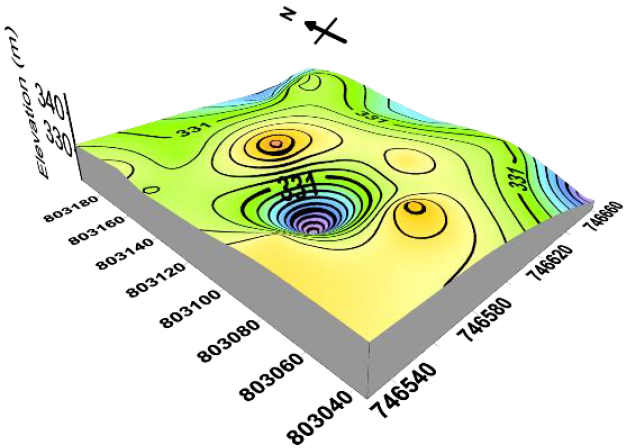
The present study applied geophysical method to engineering site investigation with the aim to delineate depth to bedrock and determine area that can induce structural failure. Direct current electrical resistivity method using Vertical Electrical Soundings (VES) field procedure and Very Low Frequency Electromagnetic (VLF-EM) profiling techniques were adopted. Twelve (12) VLF-EM profiles and twenty-four (24) VES stations were occupied. The result of VLF/EM was unable to map genuine linear structure because significant peak positive threshold fall below 20 %. Four geoelectric units comprising of topsoil, lateritic/weathered layer, partially weathered layer and fresh bedrock with resistivity values which ranged from 88.4 to 680.3 Ωm, 45.9 to 597.3 Ωm, 27.9 to 1309.1 Ωm, and 625.5 to 16,450.6 Ωm; and layer thicknesses from 0.4 to 4.2 m, 1 to 15.1 m, 2.9 to 15.1 m were delineated respectively. The bedrock configuration presents a highly undulating structural pattern due to differential weathering, with depth to bedrock range between 5.0 and 22.0 m. The study location is underlain with competent earth materials of good bearing capacity and resistivity values generally > 100 Ωm except in the bedrock depressions in the north-east, east and southern flanks where resistivity values are < 100 Ωm. Foundation of engineering structure may be designed to avoid the high-risk zone in the bedrock depressions. Shallow foundation design is recommended for small to medium engineering structures in the study but deep foundation design is recommended in the bedrock depression filled with low resistivity earth materials.
Published
How to Cite
Issue
Section
Copyright (c) 2026 Oladunjoye Peter Olabode (Author)

This work is licensed under a Creative Commons Attribution-ShareAlike 4.0 International License.
How to Cite
Similar Articles
- Fajana Opeyemi Akindeji, Adebisi Samuel Arinloye, Evaluation of Aquifer Protective Capacity Using Electrical Resistivity Method: A Case Study of Osun State University, Osogbo Campus, Southwestern Nigeria , Lafia Journal of Scientific and Industrial Research: Volume 3, Issue 1 (April, 2025), Lafia Journal of Scientific and Industrial Research (LJSIR)
- Jewel Idehen, Dennis Okonkwo, Michael Atu, Ikenna Onyegbadue, Enhancing Energy Distribution Efficiency with Dynamic Transformer Rotation in 11kV Networks , Lafia Journal of Scientific and Industrial Research: Volume 4, Issue 1 (April, 2026), Lafia Journal of Scientific and Industrial Research (LJSIR)
- Ajah Precious Amarachi , Ogbuta Philip Kelechukwu, Kalu Patience Ogbuta, Ajah Rosemary Ogechukwu, Afolabi Oluwatuyi Samson, Assessment of the Perception of Malaria Prevention among Pregnant Women Attending Antenatal Clinic at Obiozara Health Center Uburu, Ohaozara, Ebonyi State , Lafia Journal of Scientific and Industrial Research: Volume 4, Issue 1 (April, 2026), Lafia Journal of Scientific and Industrial Research (LJSIR)
- Esther Mayowa Pius, Olubunmi Bolanle Ajayi, Abubakar Mohammed, Timothy Atinuke, Olofin Opeyemi, Amina Ladidi Musa, The Effect of Post-treatment with Yellow Bitter Yam (Dioscorea dumetorum) on the Antioxidant Status of Streptozocin-induced Diabetic Rats , Lafia Journal of Scientific and Industrial Research: Volume 2, Issue 1 (April, 2024), Lafia Journal of Scientific and Industrial Research (LJSIR)
- A. S. Usman, A. B. Segun, A. M. Kaura , A. S. Mukaila, Y. Andarawus, I. M. Sanusi, S. Aliyu, L. O. Agho, T. E. Bamidele, Geochemical Characterization and Mineralization Potential of Basement Rocks in Arum, North-Central Nigeria , Lafia Journal of Scientific and Industrial Research: Volume 4, Issue 1 (April, 2026), Lafia Journal of Scientific and Industrial Research (LJSIR)
- Osuegba Osuendo Solomon, U. Adamu, S. Mamman, O. B. Aduke, S. Yusuf, D. P. Habila, B. M. Nathaniel, K. H. Uzeru, Investigation on the Mechanical Properties of Luffa (Luffa cylindrica) and Banana (Musa acuminata) Fibre Reinforced Recycled Low-Density Polyethylene (rLDPE) , Lafia Journal of Scientific and Industrial Research: Volume 3, Issue 2 (October, 2025), Lafia Journal of Scientific and Industrial Research (LJSIR)
- Abubakar Musa, Taiwo Adewumi, Sani Muhammad, Oladiran Johnson Abimbola, Low-Cost Weather Station Assessment of Urban Heat Island Compared with ERA5 Reanalysis Data , Lafia Journal of Scientific and Industrial Research: Volume 3, Issue 2 (October, 2025), Lafia Journal of Scientific and Industrial Research (LJSIR)
- Mohammed Aliyu Kaura, Abdullahi Ahmed Sule, Umar Nuhu Degree, Saidu Bello Mamudu, Yohannah Andrawus, Badamisi Muhammad Maina, Abdulrafiu Sherif, Aliyu Salihu, Use of Geoelectric Method for Groundwater Assessment in Awe Brine Area, Awe Nasarawa Nigeria , Lafia Journal of Scientific and Industrial Research: Volume 2, Issue 2 (October, 2024), Lafia Journal of Scientific and Industrial Research (LJSIR)
- Matthew Olaleke Aremu, Benjamin Musa, Victoria Idowu Adeeyo, Hamza Ibrahim Muhammad, Mohammed Alhaji Mohammed, Francis Busuyi Iyiola, Edward Bebe Ayakeme, Nutritional and Antinutritional Properties of Raw, Fermented, and Germinated Yellow Maize (Zea mays L.) , Lafia Journal of Scientific and Industrial Research: Volume 4, Issue 1 (April, 2026), Lafia Journal of Scientific and Industrial Research (LJSIR)
You may also start an advanced similarity search for this article.