
A HYBRID ENSEMBLE LEARNING APPROACH FOR ENTERPRISE NETWORK THREAT CLASSIFICATION
Keywords:
Intrusion detection systems , Hybrid ensemble learning , DDoS attack classification , Feature selection (information gain) , Data balancingAbstract
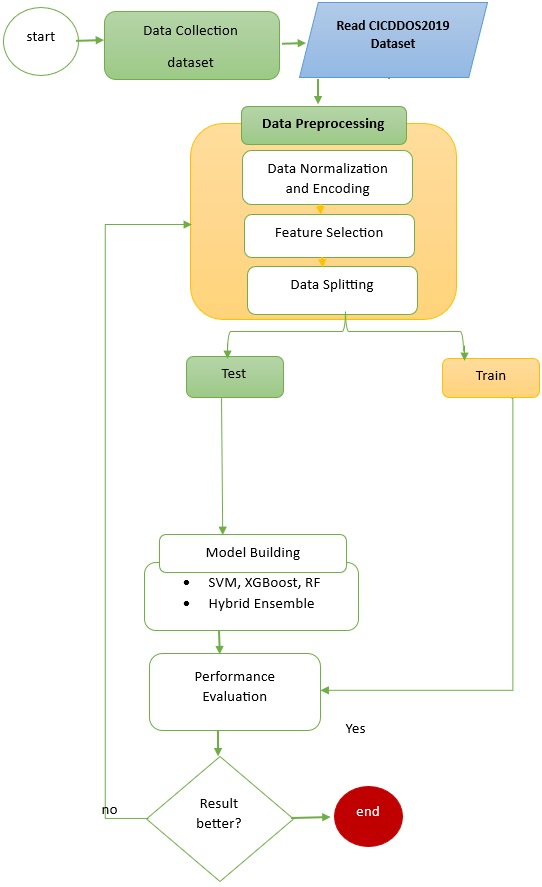
The increased number of business networks has increased the traffic levels of the networks, which increases the susceptibility to advanced types of cyber-attacks such as Distributed Denial of Service (DDoS). The current intrusion detection systems have not had the capability to address the rising pattern attacks, therefore creating a need to employ the smart data models. The study presents a hybrid model design approach that combines the Support Vector Machine (SVM) algorithm, the Random Forest (RF) algorithm, and the Extreme Gradient Boosting (XGBoost) algorithm. The experiment study is undertaken on the CICDDoS 2019 dataset platform that supports diverse benign and DDoS network attacks. Data processing corresponded to the normalization of data, data ranking through the Information Gain values, and the application of the Synthetic Minority Over-sampling Technique (SMOTE). Each of the algorithms was individually created and evaluated through accuracy, precision, recall, F1 statistics, and AUC-ROC plots. It is clear from this study work that SVM performed best on its own with almost 99.92 % accuracy and Area Under the Curve (AUC) of 0.999 percent, outperforming RF and XG-Boost. The proposed hybrid ensemble model further enhanced these measures with 99.96 % accuracy with added strengths in terms of enhanced model generalization. This study work clearly establishes that the hybrid ensemble design of optimized traditional ML models performs efficiently and is scalable on real-time scales of enterprise network threats.
Published
How to Cite
Issue
Section
How to Cite
Similar Articles
- Moshood A. Hambali, Beatrice A. Ayati, Yinusa A. Olasupo, Mu’awuya Dalhatu, Adesina A. Akinyemi, AN INTELLIGENT FEATURE-OPTIMIZED FRAMEWORK FOR DDoSATTACK DETECTION USING SVM and XGBOOST , FULafia Journal of Science and Technology : Vol. 10 No. 1 (2026): Fulafia Journal of Science and Technology (FJST)
- Lukuman Ibrahim, Samuel Isah Odoh, Dr. Jeffery O. Agushaka , AN IMPROVED BREAST CANCER DETECTION MODEL BASED ONCONVULUTIONAL NEURAL NETWORK , FULafia Journal of Science and Technology : Vol. 10 No. 2 (2026): Fulafia Journal of Science and Technology (FJST)
- Dr Olasoji I. Adekoya, Dr Solomon A. Olaleru, Dr Matthew Solomon, Kehinde A. Adewoyin, A SHORT-TERM PERFORMANCE MONITORING AND EVALUATION OF A PHOTOVOLTAIC SYSTEM AT YABA COLLEGE OF TECHNOLOGY USING A DATA LOGGER , FULafia Journal of Science and Technology : Vol. 10 No. 1 (2026): Fulafia Journal of Science and Technology (FJST)
- Samuel Oluyemi Owoeye, Folasade O. Durodola, Adetoro Taofeek, Babatunde Bisiriyu, Mahrufdeen Adegbenro, REAL-TIME IDENTIFICATION OF MAIZE PLANT AND WEEDS USING MACHINE LEARNING MODEL IMPLEMENTED VIA YOLO v5 , FULafia Journal of Science and Technology : Vol. 8 No. 2 (September, 2024): Fulafia Journal of Science and Technology (FJST)
- Adoga H. U., Ezugwu E. A., Umar M. B., OPERATING SYSTEM SECURITY AND PENETRATION TESTING , FULafia Journal of Science and Technology : Vol. 2 No. 2 (2016): Fulafia Journal of Science and Technology (FJST)
- Ayanshola A. M., Akanbi O. T., Jacob-Oricha S. O., Adeagbo T. O., Mokuolu O. A., Evaluation of Rural Water Supply Schemes in Selected Communities in Orire local government, Oyo State, Nigeria , FULafia Journal of Science and Technology : Vol. 5 No. 1 (2019): Fulafia Journal of Science and Technology (FJST)
- Yusuf Mohammed Ibrahim, Godwin Ogah, Kana Hauwa Ahmad, Hanah Eyo Nsemoh, Okposhi Isah Ibrahim, Zainab Alhassan, Jibril Lawal Imam, DETERMINATION OF TRAITS ASSOCIATION AND CONTRIBUTION AMONG AGRONOMIC AND SEED OIL TRAITS OF SESAME (Sesamum indicum L.) GENOTYPES EVALUATED IN LAFIA METROPOLIS, NASARAWA STATE, NIGERIA , FULafia Journal of Science and Technology : Vol. 10 No. 1 (2026): Fulafia Journal of Science and Technology (FJST)
- Agushaka J. O., Ezugwu A. E., Ofem P. O., Adetula E. O., Eke C. I., EXAMINATION MANAGEMENT PORTAL FOR TERTIARY INSTITUTIONS: A CASE STUDY OF FEDERAL UNIVERSITY LAFIA , FULafia Journal of Science and Technology : Vol. 1 No. 1 (2015): Fulafia Journal of Science and Technology (FJST)
- Babajide Ojo, Oyetunji B. O., Oyetunji A. K., BARRIERS TO ICT DEPLOYMENT IN THE NIGERIAN REAL ESTATE PRACTICE , FULafia Journal of Science and Technology : Vol. 4 No. 2 (2018): Fulafia Journal of Science and Technology (FJST)
- Gadzama J. J. M., Shehu J. F., Giroh D. Y., INFLUENCE OF SOCIOECONOMIC FACTORS ON WOMEN FARMERS’ ACCESS TO AGRICULTURAL INFORMATION IN MADAGALI LOCAL GOVERNMENT AREA OF ADAMAWA STATE, NIGERIA , FULafia Journal of Science and Technology : Vol. 6 No. 2 (2020): Fulafia Journal of Science and Technology (FJST)
You may also start an advanced similarity search for this article.