
POPULATION ESTIMATION AND EVALUATION OF CAUSES OF MALARIATRANSMISSION AMONG NOMADS IN TARABA STATE, NIGERIA
Keywords:
Malaria Transmission , Nomads , Health Service , Logistic regressionAbstract
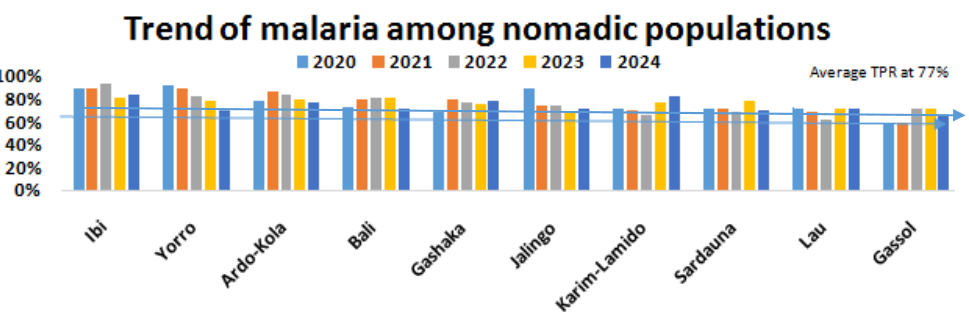
The spread of malaria and associated factors among the nomadic people in Taraba State, Nigeria, are investigated in this baseline study. Nomadic groups confront major health issues, especially with regard to malaria, because of their mobility, restricted access to healthcare, and distinct socioeconomic circumstances. The study included a mixed-methods approach to evaluate the prevalence of malaria, related risk factors, and healthcare-seeking behavior. These methods included focus groups, key informant interviews, and household surveys. The results show that high malaria prevalence, particularly during the rainy season, driven by environmental and behavioral factors. Poor health-seeking behaviors due to distance, financial barriers, and cultural perceptions. Low utilization of preventive measures like Treated Mosquito nets, cleaning of surrounding, poor/ lack of functional health facilities are the most contributed factors to the prevalence of Malaria transmission among nomadic population in Taraba state. Other environmental influences include seasonal movement patterns and closeness to water bodies, which enhance mosquito exposure, and socioeconomic restraints, such as cultural norms and financial hurdles that restrict access to treatment. The report emphasizes the critical need for focused interventions, such as community-based malaria surveillance, mobile health services, culturally appropriate health education, and easier access to insecticide-treated nets. In order to lower the prevalence of malaria and enhance general health outcomes in Taraba State, it were essential to improve healthcare delivery for these susceptible groups.
Published
How to Cite
Issue
Section
How to Cite
Most read articles by the same author(s)
- Habiba Danjuma HABIBA, IMAM AKEYEDE, UNEMPLOYMENT DYNAMICS AND MACROECONOMIC FACTORS IN NORTH-EASTERN NIGERIA: A PANEL COINTEGRATION AND CAUSALITY APPROACH , FULafia Journal of Science and Technology : Vol. 10 No. 2 (2026): Fulafia Journal of Science and Technology (FJST)
Similar Articles
- Mokuolu O. A., Aterigbade E., Salami W., Assessment of Industrial Water Pollution Level in Awun River Basin, North Central Nigeria , FULafia Journal of Science and Technology : Vol. 4 No. 2 (2018): Fulafia Journal of Science and Technology (FJST)
- Badejo A. A., Badejo A. A., Badejo A. A., Adekunle A. A., Kolade O. D., Adelaja O. T., CONSTRUCTED WETLAND SYSTEMS VEGETATED WITH DIFFERENT MACROPHYTES IN THE TREATMENT OF INDUSTRIAL WASTE WATER EFFLUENT , FULafia Journal of Science and Technology : Vol. 4 No. 2 (2018): Fulafia Journal of Science and Technology (FJST)
- Somma S. A., Akinwande N. I., SENSITIVITY ANALYSIS FOR THE MATHEMATICAL MODELLING OF MONKEY POX VIRUS INCORPORATING QUARANTINE AND PUBLIC ENLIGHTENMENT CAMPAIGN , FULafia Journal of Science and Technology : Vol. 6 No. 1 (2020): Fulafia Journal of Science and Technology (FJST)
- Akintola O. O., ASSESSMENT OF HEAVY METALS IN CHROMOLAENA ODORATA (L.) AROUND A DUMPSITE IN IBADAN, SOUTH WESTERN NIGERIA , FULafia Journal of Science and Technology : Vol. 5 No. 2 (2019): Fulafia Journal of Science and Technology (FJST)
- Akintola O. O., Adeyemi G. O., Ariyo S. O., Bodede I. A., INTEGRATED GEOPHYSICAL METHODS IN THE CHARACTERIZATION OF SUBSURFACE CONDITIONS OF LAPITE DUMPSITE IN IBADAN, SOUTHWESTERN NIGERIA , FULafia Journal of Science and Technology : Vol. 5 No. 2 (2019): Fulafia Journal of Science and Technology (FJST)
- Onuk E. G., Anzaku T. A. K., Zaknayiba D. B., ECONOMIC ANALYSIS OF DRY SEASON VEGETABLE FARMING AMONG WOMEN IN MAKURDI LOCAL GOVERNMENT AREA OF BENUE STATE, NIGERIA , FULafia Journal of Science and Technology : Vol. 3 No. 2 (2017): Fulafia Journal of Science and Technology (FJST)
- Ndubisi Onwuanyi, Pius E. Chima, URBAN GOVERNANCE AND THE ENVIRONMENT IN ABA AND ONITSHA , FULafia Journal of Science and Technology : Vol. 6 No. 1 (2020): Fulafia Journal of Science and Technology (FJST)
- Mairiga J. P., Gyar S. D., JameyPeters Y. M., PHENYLTHIOCARBAMIDE TASTE SENSITIVITY AS A POTENTIAL GENETIC MARKER FOR PRESCRIPTION DRUGS AND SUBSTANCE MISUSE , FULafia Journal of Science and Technology : Vol. 7 No. 2 (2021): Fulafia Journal of Science and Technology (FJST)
- Olasunkanmi O. G., Olaluwoye O. O., Alao P. O., Osifeko M. O., SYNERGY OF EFFECTIVE POWER SECTOR AND TOWN PLANNING UNIT , FULafia Journal of Science and Technology : Vol. 4 No. 2 (2018): Fulafia Journal of Science and Technology (FJST)
- Adeyemi H. O., David A. O., Akinyemi O. O., Opafola O. T., Adeyemi O. A., ENHANCING OCCUPATIONAL SAFETY AND HEALTH IN CONSTRUCTION MANUAL HANDLING OF LOAD: TEAM-LIFTING POSSIBILITY AND IMPACTS , FULafia Journal of Science and Technology : Vol. 4 No. 1 (2018): Fulafia Journal of Science and Technology (FJST)
You may also start an advanced similarity search for this article.