Computational Investigation of 2,3-Dihydroquinazolin-4(1H)-one Derivatives as Multitarget Anti-Alzheimer Agents
DFT and Molecular Docking Studies against AChE, BChE, and BACE1
Keywords:
Alzheimer's disease , 2,3-Dihydroquinazolin-4(1H)-one , , Molecular docking , Density functional theory , Multitarget inhibitorsAbstract
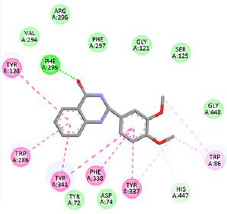
Alzheimer's disease (AD) remains one of the greatest unmet medical needs worldwide and requires a multitarget therapeutic approach as a result of its multifactorial pathogenesis. The 2,3-dihydroquinazolin-4(1H)-one scaffold is a pharmacologically privileged drug known to possess neuroprotective, antioxidant, and enzyme-inhibitory activities that are relevant to AD. Six structurally diverse derivatives (3a, 3k, 3m, 3n, 3r, and 3u) were computationally investigated against three important enzymes associated with AD (acetylcholinesterase (AChE), butyrylcholinesterase (BChE), and β-secretase 1 (BACE1)). Molecular electrostatic potential maps, quantum chemical reactivity descriptors, and frontier molecular orbital analysis were calculated via the density functional theory (DFT) method at the M062X/def2TZVP level. The molecular docking was done using the Glide program of Maestro against co-crystallized protein structures (PDB: 7E3H, 7AIY, 5HU1) with Rivastigmine and Verubecestat as reference drugs. DFT analysis showed that compound 3n is the most chemically reactive compound with a HOMO–LUMO gap of 6.51 eV, and compound 3r is the most electrophilic with ω = 2.40 eV. The molecular docking revealed that 3k showed the highest binding affinity towards all three targets (AChE: −11.22 kcal/mol, BChE: −8.17 kcal/mol, BACE1: −7.78 kcal/mol) as compared to Rivastigmine (AChE: −6.66 kcal/mol, BChE: −5.21 kcal/mol). Analysis of interactions indicated that aromatic π–π stacking and hydrogen bonding are the predominant types of interactions involved in the binding of AChE, hydrophobic interactions are predominant in the binding of BChE, and polar interactions are predominant in the binding of BACE1. These results identify 3k as a potential multitarget agent that requires further experimental studies
Published
How to Cite
Issue
Section
Copyright (c) 2026 Abosede Adejoke Badeji, Olalekan Samuel, Segun D. Oladipo, Adejoke D. Osinubi, Adetoro A. Osanyinbi, Isaac Adebayo Akinbulu (Author)

This work is licensed under a Creative Commons Attribution-ShareAlike 4.0 International License.
How to Cite
Similar Articles
- Jewel Idehen, Dennis Okonkwo, Michael Atu, Ikenna Onyegbadue, Enhancing Energy Distribution Efficiency with Dynamic Transformer Rotation in 11kV Networks , Lafia Journal of Scientific and Industrial Research: Volume 4, Issue 1 (April, 2026), Lafia Journal of Scientific and Industrial Research (LJSIR)
- Bashiru Sani, Praise Wraiba, Aleruchi Chuku, Prevalence of Candida Species Among Unmarried Women Attending Lafia Primary Health Care Centers , Lafia Journal of Scientific and Industrial Research: Volume 2, Issue 1 (April, 2024), Lafia Journal of Scientific and Industrial Research (LJSIR)
- Osuegba Osuendo Solomon, U. Adamu, S. Mamman, O. B. Aduke, S. Yusuf, D. P. Habila, B. M. Nathaniel, K. H. Uzeru, Investigation on the Mechanical Properties of Luffa (Luffa cylindrica) and Banana (Musa acuminata) Fibre Reinforced Recycled Low-Density Polyethylene (rLDPE) , Lafia Journal of Scientific and Industrial Research: Volume 3, Issue 2 (October, 2025), Lafia Journal of Scientific and Industrial Research (LJSIR)
- Pedro Akharenegbe, Maryam Isah, Hannah Eyo Nsemoh, Glory Jayeoba, Okposhi Isah Ibrahim, Prevalence and Environmental Determinants of Aflatoxin Contamination in Maize Sold in Open Markets Across Nasarawa State, Nigeria , Lafia Journal of Scientific and Industrial Research: Volume 3, Issue 1 (April, 2025), Lafia Journal of Scientific and Industrial Research (LJSIR)
- Busuyi Francis Iyiola, David Ndubisi Ezeh, Students’ Attitude and Gender as Determinants of Colleges of Education Students’ Academic Achievement in Chemistry , Lafia Journal of Scientific and Industrial Research: Volume 2, Issue 2 (October, 2024), Lafia Journal of Scientific and Industrial Research (LJSIR)
- Kenneth Emeka Omuekwu, Titilayomi Akande, Bawa Inalegwu, Ogor A. Ogor Ogor, Pedro Akharenegbe, Abdullahi Iliyasu Hussaini, Hypolipidemic and Antioxidant Effects of Methanolic Cucumis sativus Fruit Extract in Poloxamer 407-Induced Hyperlipidemic Rats , Lafia Journal of Scientific and Industrial Research: Volume 4, Issue 2 (October, 2026), Lafia Journal of Scientific and Industrial Research (LJSIR) [IN PROGRESS]
- Mohammed Aliyu Kaura, Abdullahi Ahmed Sule, Umar Nuhu Degree, Saidu Bello Mamudu, Yohannah Andrawus, Badamisi Muhammad Maina, Abdulrafiu Sherif, Aliyu Salihu, Use of Geoelectric Method for Groundwater Assessment in Awe Brine Area, Awe Nasarawa Nigeria , Lafia Journal of Scientific and Industrial Research: Volume 2, Issue 2 (October, 2024), Lafia Journal of Scientific and Industrial Research (LJSIR)
- Vanenchii Peter Ayoo, Katmol Yunana Damap, Hassan Ibrahim, 3 Point Block Backward Differentiation Formula with Multiple Off-Step Points for the Solution of Stiff Problems , Lafia Journal of Scientific and Industrial Research: Volume 3, Issue 2 (October, 2025), Lafia Journal of Scientific and Industrial Research (LJSIR)
- Olusegun Kehinde Abiola, Wasiu Olasunkanmi Kazeem, Synsepalum dulcificum extract as green corrosion inhibitor for acid corrosion of mild steel in HCl solution , Lafia Journal of Scientific and Industrial Research: Volume 2, Issue 1 (April, 2024), Lafia Journal of Scientific and Industrial Research (LJSIR)
You may also start an advanced similarity search for this article.