Forecasting Nigerian Stock Prices Using LSTM and ARIMAX
Keywords:
LSTM , ARIMAX , Stock Forecasting , Time Series , VolatilityAbstract
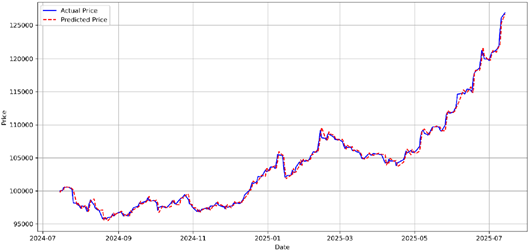
Stock price volatility presents major challenges for investors and policymakers, particularly in emerging markets. This study evaluates the performance of Long Short-Term Memory (LSTM) networks and ARIMAX models for forecasting stock prices on the Nigerian Stock Exchange (NSE). Using 13 years (2012–2025) of daily stock price data, the dataset was preprocessed with lag feature engineering and normalization to enhance model learning and stability. The LSTM model, designed with three stacked layers and dropout regularization, was trained on temporally split data to simulate realistic forecasting conditions. Forecast accuracy was assessed using Mean Absolute Percentage Error (MAPE), Root Mean Square Error (RMSE), and a Forecast Accuracy Index. The ARIMAX model achieved lower errors (MAPE = 0.37%, RMSE = 537.23) and higher forecast accuracy (99.63%) compared to LSTM (MAPE = 0.92%, RMSE = 1486.39, Accuracy = 99.08%). Despite ARIMAX’s superior numerical performance, the LSTM model demonstrated strong capability in capturing non-linear patterns and long-term temporal dependencies. These results highlight the strategic value of LSTM networks for modeling complex dynamics in volatile markets, while ARIMAX remains effective for short-term, trend-dominated forecasting. The study provides empirical evidence for the complementary use of deep learning and traditional econometric approaches in emerging financial markets.
Published
How to Cite
Issue
Section
Copyright (c) 2026 Joshua Ezra Joeffrey, Joseph Uchenna Okeke, Peter Bako Jaben, Joseph Navokhi (Author)

This work is licensed under a Creative Commons Attribution-ShareAlike 4.0 International License.
How to Cite
Similar Articles
- Adamu Mohammed Abdullahi, Benson Shadrach Jatau, Ishaq Ya'u Tanko, Constraining the Genesis of Barite Deposits of the Gombe Hill, Using Stable Isotopes and Fluid Inclusion Studies , Lafia Journal of Scientific and Industrial Research: Volume 3, Issue 2 (October, 2025), Lafia Journal of Scientific and Industrial Research (LJSIR)
- Vanenchii Peter Ayoo, Katmol Yunana Damap, Hassan Ibrahim, 3 Point Block Backward Differentiation Formula with Multiple Off-Step Points for the Solution of Stiff Problems , Lafia Journal of Scientific and Industrial Research: Volume 3, Issue 2 (October, 2025), Lafia Journal of Scientific and Industrial Research (LJSIR)
- Okponmwense Moses, Omoye Shelah Omonzejie, Lawrence Ojong Ndip, Effect of Magnesium Oxide-Carbonized Hibiscus Sabdariffa (Zobo) Waste and Magnesium–Zinc Binary Oxide Nanocomposites in Mitigating Cadmium and Bacteria in Contaminated Water. , Lafia Journal of Scientific and Industrial Research: Volume 3, Issue 1 (April, 2025), Lafia Journal of Scientific and Industrial Research (LJSIR)
- Emmanuel M. Ikegwu, Gbenga B. Karokatose, Muhammad A. Idris, Bayesian Modelling of Family Planning Discontinuation under Socioeconomic and Environmental Uncertainty in Rural Communities in South East Nigeria , Lafia Journal of Scientific and Industrial Research: Volume 4, Issue 2 (October, 2026), Lafia Journal of Scientific and Industrial Research (LJSIR) [IN PROGRESS]
You may also start an advanced similarity search for this article.