
LOCAL HABITAT CONDITIONS DRIVE MORPHOMETRIC VARIATIONS, BUT NOT SPATIAL PATTERNS OF Anopheles MOSQUITOES IN NORTH-CENTRAL, NIGERIA
Mots-clés :
Array, Array, Array, Array, ArrayRésumé
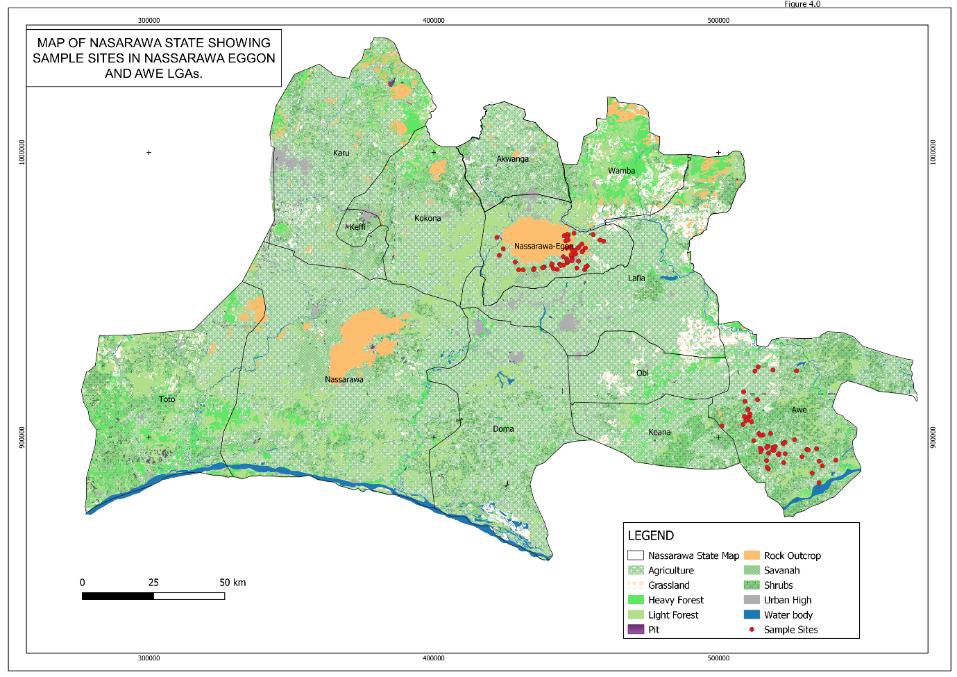
Morphological traits of species have been used to distinguish variations within and among closely related mosquito species, to understand how phenotypic adaptations can influence malaria transmission dynamics. Here, we investigated the morphometric variations of Anopheles larvae collected from diverse aquatic habitats. Mosquito larvae were reared to adulthood under controlled conditions, and external morphological parameters (i.e., antenna, palp, proboscis, thorax, abdomen, wing, femur, tibia, and tarsus) were measured using a calibrated dissecting microscope. Data were analysed using one-way Analysis of Variance (ANOVA) followed by DuncanMultiple Range Test (DMRT), with test of significance at P <0.05. We found significant interspecific differences (P <0.001) in most morphometric traits among mosquito species, with An. coustani consistently showed the largest body measurements, while An. gambiae showed the smallest dimensions. Despite differences in morphometric traits among mosquito species, we found little evidence to suggest that mosquito species varied in their spatial occurrence dynamics across the two LGAs, indicating an influence of local habitat conditions on certain phenotypic traits of mosquito species, but not their occurrence patterns. In the context of global change, there is an urgent need to continue investigating how local environmental conditions directly or indirectly impact vector-borne insects, considering morphological traits that are key to species’ fitness and disease transmission ability.
Publiée
Comment citer
Numéro
Rubrique
Comment citer
Articles les plus lus par le ou les mêmes auteur/ices
- Victor Ameh Adejoh, Victoria A. Pam, Akwashiki Ombugadu, James Ishaku Maikenti, Mohammed A. Ashigar, Habitat Characterization of Culicine Mosquitoes in Two Local Government Areas of Nasarawa State, Nigeria , FULafia Journal of Science and Technology : Vol. 9 No 1 (2025): Vol. 9 No. 1 (March, 2025): Fulafia Journal of Science and Technology (FJST)
- Simon Odey, Victoria Pam, James Maikenti, Mohammed Ashigar, Akwashiki Ombugadu, Hussein Ahmed, M. R. Abubakar, Isaac Joshua, PHYTOCHEMICAL COMPOSITION AND FUNCTIONAL GROUP PROFILE OF Millettia aboensis EXTRACTS TO ELUCIDATE THEIR BIOCHEMICAL BASIS FOR LARVICIDALACTIVITY AGAINST Anopheles AND Culex MOSQUITOES , FULafia Journal of Science and Technology : Vol. 10 No 2 (2026): Fulafia Journal of Science and Technology (FJST)
Articles similaires
- C. C. Nweze, M. Solomon, A. B. Yako, M. O. Enemali, IMMUNE SYSTEM RESPONSE TO CHANGES IN DIFFERENT ANTIOXIDANT DIETARY INTERVENTION ON STAFF OF NASARAWA STATE UNIVERSITY, KEFFI , FULafia Journal of Science and Technology : Vol. 3 No 1 (2017): Fulafia Journal of Science and Technology (FJST)
- Ehizonomhen Solomon Okonofua, Nicholas Omugbo Uwadia, Juliet Akpejiori, GROUNDWATER QUALITY ASSESSMENT AROUND IGBATORO DUMP YARD USING GEOSPATIAL TECHNOLOGY , FULafia Journal of Science and Technology : Vol. 5 No 1 (2019): Fulafia Journal of Science and Technology (FJST)
Vous pouvez également Lancer une recherche avancée de similarité pour cet article.