
GROWTH AND ANATOMICAL RESPONSES OF TOMATO (LYCOPERSICON ESCULENTUM ) UNDER MICROGRAVITY AND NORMAL GRAVITY CONDITIONS
Mots-clés :
anatomy , clinostat , germination , microgravity , Lycopersicon esculentumRésumé
Microgravity is known to be a major abiotic stress in space which affects plants depending on the duration of
exposure. In this research, tomato seeds were exposed to long hours of simulated microgravity condition using
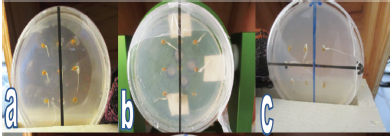
a one-axis clinostat. The seeds were sown on a 1.5% combination of plant nutrient and agar-agar solidified
medium in three Petri dishes. One of the Petri dishes was mounted on the clinostat and allowed to rotate at
the speed of 20 rpm for 72 hours while the others were subjected to the normal gravity vector. The anatomical
sections of both clinorotated and normal gravity plants were made after 72 hours and observed using a Phase
contrast digital microscope. The percentage germination as well as the growth rate of the normal gravity seeds was higher than the clinorotated treatments. The orientation of the clinorotated roots during germination were in different directions unlike the normal gravity which all germinated towards the direction of gravity vector. The clinostat was able to switch off gravistimulation as distinct cellular arrangement was observed for the tomato plants under normal gravity condition unlike those of the clinorotated treatment. The results revealed that the thickness of the epidermis and cortex of the roots of normal gravity are higher than those of clinorotated. This suggests that under long-term microgravity exposure, plants can acclimatize to the stress by changing their internal cellular features such as reduction in the thickness of cells and rate of cell proliferation.
Publiée
Comment citer
Numéro
Rubrique
Comment citer
Articles les plus lus par le ou les mêmes auteur/ices
- T. P. terna, E. H. Kwon-Ndung, G. F. Akomolafe, E. E. Goler, J. I. Okogbaa, J. I. Waya, M. Markus, SOME ETHNOBOTANICAL USES OF PLANT RESOURCES IN NASARAWA STATE, NIGERIA , FULafia Journal of Science and Technology : Vol. 2 No 2 (2016): Fulafia Journal of Science and Technology (FJST)
- O. A. Falaiye, O. J. Abimbola, J. Omojola, D. S. Akinyanju, Nwamaka R. Okonkwo, SPACIO-TEMPORAL VARIATION OF RADIO REFRACTIVITY IN LAFIA, NASARAWA STATE USING CM SAF ATOVS SATELLITE DATA , FULafia Journal of Science and Technology : Vol. 2 No 1 (2016): Fulafia Journal of Science and Technology (FJST)
- E. E. Goler, E. H. Kwon-Ndung, G. F. Akomolafe, T. P. Terna, J. I. Waya, M. Markus, ETHNOMEDICINAL ASSETS OF PLANTS COLLECTED FROM NASARAWA STATE, NORTH CENTRAL NIGERIA , FULafia Journal of Science and Technology : Vol. 3 No 1 (2017): Fulafia Journal of Science and Technology (FJST)
- T. P. Terna, G. F. Akomolafe, M. Avworho, J. I. Okogbaa, J. Omojola, RESPONSES OF DIFFERENT TOMATO VARIETIES TO DISEASE STRESS UNDER DIFFERENT CONDITIONS OF GRAVITY , FULafia Journal of Science and Technology : Vol. 3 No 1 (2017): Fulafia Journal of Science and Technology (FJST)
- J. Omojola, S. C. Adediwura, E. S. Joshua, A. M. Mustapha, NEQUICK MODEL PREDICTIONS AND THE OBSERVED TOTAL ELECTRON CONTENT (TEC) OVER NIGERIA , FULafia Journal of Science and Technology : Vol. 2 No 1 (2016): Fulafia Journal of Science and Technology (FJST)
- G. F. Akomolafe, J. I. Okogbaa, PRELIMINARY TOXICITY EVALUATION OF SOIL CONTAMINATED WITH PETROLEUM DERIVATIVES ON SOME CROP PLANTS , FULafia Journal of Science and Technology : Vol. 3 No 1 (2017): Fulafia Journal of Science and Technology (FJST)
Articles similaires
- T. P. Terna, G. F. Akomolafe, M. Avworho, J. I. Okogbaa, J. Omojola, RESPONSES OF DIFFERENT TOMATO VARIETIES TO DISEASE STRESS UNDER DIFFERENT CONDITIONS OF GRAVITY , FULafia Journal of Science and Technology : Vol. 3 No 1 (2017): Fulafia Journal of Science and Technology (FJST)
- A. N. Ude, Christian Egwumah, O. J. Balogun, Sadiya Balogun, Abraham Korede, P. B. Akwu, Abayomi Ajayi, DOSE RESPONSE OF AQUEOUS, METHANOLIC, AND LIME JUICE EXTRACTS OF COMBINED MORINGA OLEIFERA AND VERNONIA AMYGDALINA IN RABBITS , FULafia Journal of Science and Technology : Vol. 5 No 2 (2019): Fulafia Journal of Science and Technology (FJST)
- G. F. Akomolafe, J. I. Okogbaa, PRELIMINARY TOXICITY EVALUATION OF SOIL CONTAMINATED WITH PETROLEUM DERIVATIVES ON SOME CROP PLANTS , FULafia Journal of Science and Technology : Vol. 3 No 1 (2017): Fulafia Journal of Science and Technology (FJST)
- Godwin Ogah, Maiyaki, Eze, Happiness, Taibat, Iga, Ukpong, Noah, Morpho-Phytochemical Composition of Sesame (Sesamum indicum L.) Varieties Grown in Lafia, Nasarawa State, Nigeria , FULafia Journal of Science and Technology : Vol. 9 No 1 (2025): Vol. 9 No. 1 (March, 2025): Fulafia Journal of Science and Technology (FJST)
- A. Ajayi, A. N. Ude, O. J. Balogun, QUALITATIVE AND QUANTITATIVE PHYTOCHEMICAL ANALYSIS OF MORINGA OLEIFERA AND VERNONIA AMYGDALINA , FULafia Journal of Science and Technology : Vol. 3 No 2 (2017): Fulafia Journal of Science and Technology (FJST)
- M. A. Ittah, E. E. Francis, GROWTH AND YIELD TRAITS OF GROUNDNUT(ARACHIS HYPOGAEA) LINES TREATED WITH HYDROGEN PEROXIDE , FULafia Journal of Science and Technology : Vol. 2 No 1 (2016): Fulafia Journal of Science and Technology (FJST)
- Hauwa Ahmad Kana, Godwin Omame Ogah, Adama Ababarabi Umar, EVALUATION OF IMPROVED SOYBEAN (Glycine max (L.) Merr.) GENOTYPES TREATED WITH IRON NANOPARTICLES , FULafia Journal of Science and Technology : Vol. 10 No 2 (2026): Fulafia Journal of Science and Technology (FJST)
Vous pouvez également Lancer une recherche avancée de similarité pour cet article.