INVESTIGATING THE EFFECTS OF PRE-TREATMENT WITH GRANULATEDPLANTAIN PEEL ON BIOGAS PRODUCTION FROM POULTRY WASTE
Keywords:
Array, Array, Array, Array, ArrayAbstract
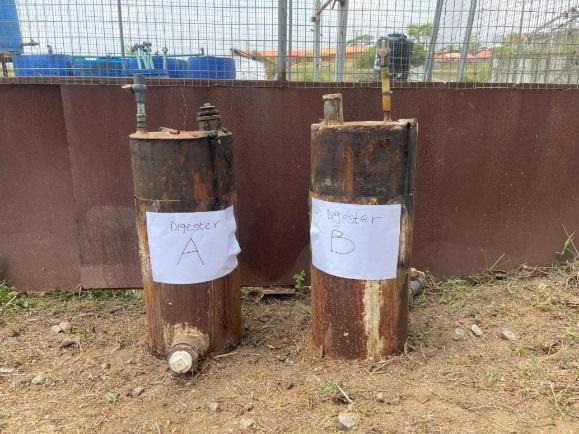
The continued reliance on wood and fossil fuels has demonstrably negative environmental and economic consequences. These include significant contributions to carbon emissions and global warming, as well as economic instability driven by volatile energy markets, as evidenced by recent price surges in petroleum products in regions such as Nigeria. Thus, there is a pressing need to develop energy sources that are both protective and restorative to the environment. This study investigates the pre-treatment of poultry waste with granulated plantain peels (GPP) as a pre-treatment agent to enhance both the yield and quality of biogas. Conducted over 53 days using two laboratory-scale bio-digesters, one fed a mixture of poultry waste and GPP and a control bio-digester receiving only poultry waste, gas production was measured at five-day intervals. The pre-treated substrate yielded a cumulative 52,650.6 cm³ of biogas, a 140 % increase over the 21,928.6 cm³ from the untreated control. Flammability testing indicated an accelerated production onset, with biogas from the pre-treated mixture igniting from the first day and exhibiting appreciable methane content by days 3–4, whereas the control began production on day 3, with significant methane observed only by days 4–5. Furthermore, a compression test demonstrated the technical feasibility of storing the biogas, showing a minimal temperature increase of 0.19 °C per psi during pressurization.
Published
How to Cite
Issue
Section
How to Cite
Most read articles by the same author(s)
- Victor Oluwayomi Adepoju, Adewole Ayobami Aderinlewo, Olawale Usthman Dairo, Olayide Rasaq Adetunji, EFFECT OF MOISTURE CONTENT OF TWO VARIETIES OF PALM KERNEL ANDSHELL ON THE COEFFICIENT OF SLIDING FRICTION OF A LOCAL FABRIC , FULafia Journal of Science and Technology : Vol. 10 No. 1 (2026): Fulafia Journal of Science and Technology (FJST)
Similar Articles
- Angyu A. E., Garjila Y., Madi B. D., GROWTH AND YIELD RESPONSES OF SOYA BEAN (Glycine max L.) TO VARYING SPACING IN JALINGO, TARABA STATE , FULafia Journal of Science and Technology : Vol. 3 No. 2 (2017): Fulafia Journal of Science and Technology (FJST)
- A. A. Badmos, S. A. Muhammed, M. O Kazeem, P. O. Ben-Uwabor, S. A. Oyeyinka, A. O. Lawal, NUTRITIONAL, MICROBIAL, SENSORY AND COST ATTRIBUTES OF WARA, WAGASHI,CHEDDAR AND MOZZARELLA CHEESE TYPES , FULafia Journal of Science and Technology : Vol. 10 No. 1 (2026): Fulafia Journal of Science and Technology (FJST)
- Badejo A. A., Badejo A. A., Badejo A. A., Adekunle A. A., Kolade O. D., Adelaja O. T., CONSTRUCTED WETLAND SYSTEMS VEGETATED WITH DIFFERENT MACROPHYTES IN THE TREATMENT OF INDUSTRIAL WASTE WATER EFFLUENT , FULafia Journal of Science and Technology : Vol. 4 No. 2 (2018): Fulafia Journal of Science and Technology (FJST)
- Onuk E. G., Umar H. S., Girei A. A., ANALYSIS OF BROILER PRODUCTION IN THE SOUTHERN AGRICULTURAL ZONE OF NASARAWA STATE, NIGERIA , FULafia Journal of Science and Technology : Vol. 3 No. 2 (2017): Fulafia Journal of Science and Technology (FJST)
- A. A. Badmos, S. A. Kanimodo, S. A. Oyeyinka, P. O. Ben-Uwabor, A. O. Lawal, NUTRITIVE ATTRIBUTES OF COCONUT FRUIT JUICE AS ADDITIVE TO YOGHURT , FULafia Journal of Science and Technology : Vol. 10 No. 1 (2026): Fulafia Journal of Science and Technology (FJST)
- Usman N. I., Yusuf A. A., Abdu N., Ndor E., Azagaku D. E., SCREENHOUSE EVALUATION OF GROUNDNUT GENOTYPES FORNITROGEN FIXATION AND MAIZE VARIETIES FOR NITROGENUPTAKE EFFICIENCY , FULafia Journal of Science and Technology : Vol. 1 No. 1 (2015): Fulafia Journal of Science and Technology (FJST)
- Nyam D. D., Jiya J. B., M. D. Sila, E. E. Goler, H. A. Kana, E. H. Kwon-Ndung, GENETIC VARIABILITY AND INTERRELATIONSHIP BETWEEN GRAIN YIELD AND SOME MORPHOLOGICAL AND REPRODUCTIVE TRAITS OF ACHA (Digitaria spp.) ACCESSIONS , FULafia Journal of Science and Technology : Vol. 6 No. 2 (2020): Fulafia Journal of Science and Technology (FJST)
- Makut M. D., Ogundiya O. L., PRODUCTION OF BIOETHANOL USING PAPER WASTES AS SUBSTRATES , FULafia Journal of Science and Technology : Vol. 3 No. 1 (2017): Fulafia Journal of Science and Technology (FJST)
- Ari M. M., Gambo D., Alu S. E., Edwin E. E., Aminu R. A., Isa J. M., Yanduma M., OUTCOME OF CALCIUM AND PHOSPHOROUS MINERAL SOURCES ON PERFORMANCE, CARCASS AND BONES CHARACTERISTICS OF BROILERS , FULafia Journal of Science and Technology : Vol. 2 No. 2 (2016): Fulafia Journal of Science and Technology (FJST)
- Gambo D., Carew S. N., Winifred P. M., EFFECTS OF ACCESS TO PASTURE AND INTEGRATION WITH RABBITS ON PERFORMANCE AND CARCASS CHARACTERISTICS OF BROILER CHICKEN , FULafia Journal of Science and Technology : Vol. 2 No. 2 (2016): Fulafia Journal of Science and Technology (FJST)
You may also start an advanced similarity search for this article.