
A HYBRID ENSEMBLE LEARNING APPROACH FOR ENTERPRISE NETWORK THREAT CLASSIFICATION
Keywords:
Intrusion detection systems , Hybrid ensemble learning , DDoS attack classification , Feature selection (information gain) , Data balancingAbstract
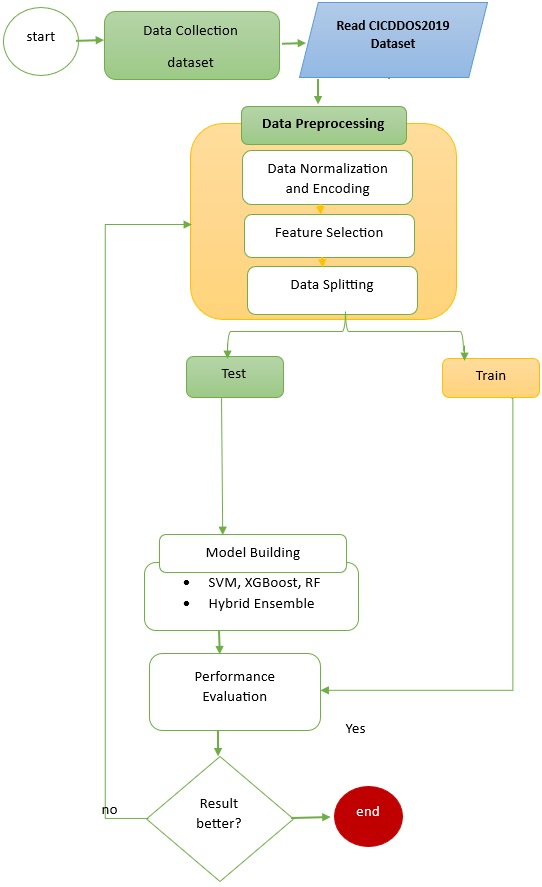
The increased number of business networks has increased the traffic levels of the networks, which increases the susceptibility to advanced types of cyber-attacks such as Distributed Denial of Service (DDoS). The current intrusion detection systems have not had the capability to address the rising pattern attacks, therefore creating a need to employ the smart data models. The study presents a hybrid model design approach that combines the Support Vector Machine (SVM) algorithm, the Random Forest (RF) algorithm, and the Extreme Gradient Boosting (XGBoost) algorithm. The experiment study is undertaken on the CICDDoS 2019 dataset platform that supports diverse benign and DDoS network attacks. Data processing corresponded to the normalization of data, data ranking through the Information Gain values, and the application of the Synthetic Minority Over-sampling Technique (SMOTE). Each of the algorithms was individually created and evaluated through accuracy, precision, recall, F1 statistics, and AUC-ROC plots. It is clear from this study work that SVM performed best on its own with almost 99.92 % accuracy and Area Under the Curve (AUC) of 0.999 percent, outperforming RF and XG-Boost. The proposed hybrid ensemble model further enhanced these measures with 99.96 % accuracy with added strengths in terms of enhanced model generalization. This study work clearly establishes that the hybrid ensemble design of optimized traditional ML models performs efficiently and is scalable on real-time scales of enterprise network threats.
Published
How to Cite
Issue
Section
How to Cite
Similar Articles
- Godwin Omame Ogah, Ambo Idzi Amos, Hauwa Ahmad Kana, IMPACT OF ALPHA SPIN NANOPARTICLES ON GENETIC DIVERSITY OFNIGERIA SESAME (Sesamum indicum L.) GERMPLASM
- Fatima Yusuf Al-mustapha fatima, Aleruchi Chuku, Bashir Eya Sani, Abdulaziz Dardau Aliyu, Najaatu Shehu Hadi, Okposhi Usman Shuaibu, Peter Uteh Upla, Microscopy and Antigenic Detection of Trichomonas vaginalis Infections among Female Patients Attending the Gynecology Unit of Dalhatu Araf Specialist Hospital, Lafia. , FULafia Journal of Science and Technology : Vol. 8 No. 2 (September, 2024): Fulafia Journal of Science and Technology (FJST)
- Yako A. B., Nweze C. C., Ogunnu F. J., Chessed G., AN EPIDEMIC OF COCCIDIOSIS IN CHICKENS SOLD IN KEFFI CENTRAL MARKET, NASARAWA STATE, NIGERIA , FULafia Journal of Science and Technology : Vol. 2 No. 2 (2016): Fulafia Journal of Science and Technology (FJST)
- Nsien E. F., Abam A. O., LJUNG-BOX AUTOREGRESSIVE MODEL FOR THE RETURNS OF THREE NIGERIAN INSURANCE COMPANIES’ STOCKS , FULafia Journal of Science and Technology : Vol. 5 No. 2 (2019): Fulafia Journal of Science and Technology (FJST)
- Malann Y. D., Oguegbe N. G., Deme G. G., COMPARATIVE DIAGNOSIS OF MALARIA USING ROUTINE MICROSCOPY AND RAPID DIAGNOSTIC TECHNIQUE WITH LACTAN DEHYDROGENASE
- Adeoye T. O., Johnson L. M., Ologe O., THE APPLICATION 3D SEISMIC DATA INTERPRETATION TO HYDROCARBON PROSPECT MAPPING IN “DEDE”FIELD,NIGER DELTA , FULafia Journal of Science and Technology : Vol. 2 No. 2 (2016): Fulafia Journal of Science and Technology (FJST)
- Alu S. E., RESPONSE OF WEANER RABBITS TO GRADED LEVEL OF OFFAL BASED DIETS OF TIGER NUT (Cyperus esculentus) , FULafia Journal of Science and Technology : Vol. 1 No. 1 (2015): Fulafia Journal of Science and Technology (FJST)
- Adebisi O. I., Adejumobi A. I., Olanipekun A. J., Bello O. H., DEVELOPMENT OF A FUEL LEVEL MEASURING SYSTEM FOR UNDERGROUND LIQUID TANKS , FULafia Journal of Science and Technology : Vol. 4 No. 2 (2018): Fulafia Journal of Science and Technology (FJST)
- Onuk E. G., Umar H. S., Girei A. A., ANALYSIS OF BROILER PRODUCTION IN THE SOUTHERN AGRICULTURAL ZONE OF NASARAWA STATE, NIGERIA
- Hauwa Ahmad Kana, Godwin Omame Ogah, Adama Ababarabi Umar, EVALUATION OF IMPROVED SOYBEAN (Glycine max (L.) Merr.) GENOTYPES TREATED WITH IRON NANOPARTICLES
You may also start an advanced similarity search for this article.